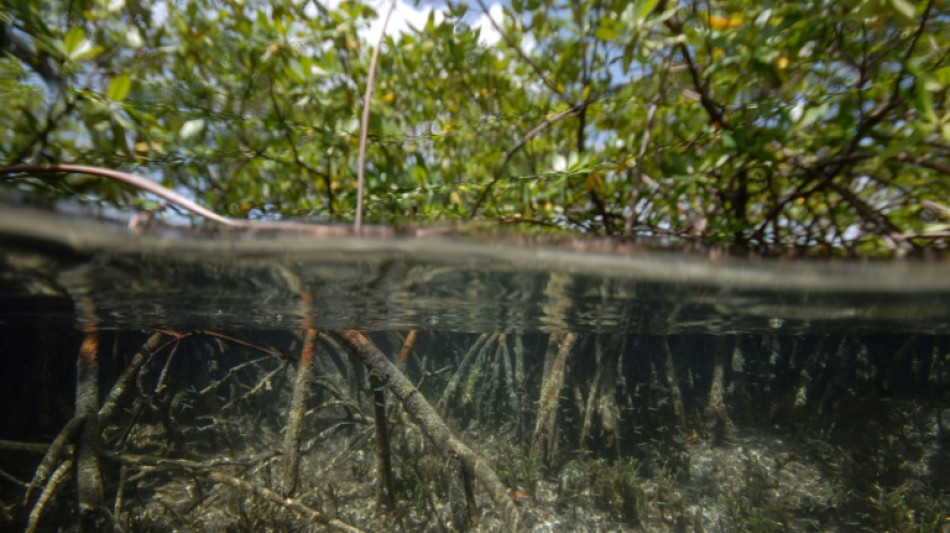
World's largest bacteria discovered in Guadeloupe / Photo: © Lawrence Berkeley National Laboratory/AFP

You can see it with the naked eye and pick it up with a pair of tweezers -- not bad for a single bacteria.
Scientists say they have discovered the world's largest variety in the mangroves of Guadeloupe -- and it puts its peers to shame.
At up to two centimetres (three-quarters of an inch), "Thiomargarita magnifica" is not only around 5,000 times bigger than most bacteria -- it boasts a more complex structure, according to a study published in the journal Science on Thursday.
The discovery "shakes up a lot of knowledge" in microbiology, Olivier Gros, professor of biology at the University of the Antilles and co-author of the study, told AFP.
In his laboratory in the Caribbean island group city of Pointe-a-Pitre, he marvelled at a test tube containing strands that look like white eyelashes.
"At first I thought it was anything but a bacterium because something two centimetres (in size) just couldn't be one", he said.
The researcher first spotted the strange filaments in a patch of sulphur-rich mangrove sediment in 2009.
Techniques including electronic microscopy revealed it was a bacterial organism, but there was no guarantee it was a single cell.
- 'As tall as Mount Everest' -
Molecular biologist Silvina Gonzalez-Rizzo, from the same laboratory, found it belonged to the Thiomargarita family, a bacterial genus known to use sulphides to grow. And a researcher in Paris suggested they were indeed dealing with just one cell.
But a first attempt at publication in a scientific journal a few years later was aborted.
"We were told: 'This is interesting, but we lack the information to believe you'," Gros said, adding that they needed stronger images to provide proof.
Then a young researcher, Jean-Marie Volland, managed to study the bacterium with the Lawrence Berkeley National Laboratory, run by the University of California.
With financial backing and access to some of the best tools in the field, Volland and his colleagues began building up a picture of the colossal bacteria.
It was clearly enormous by bacterial standards -- scaled up to human proportions, it would be like meeting someone "as tall as Mount Everest", Volland said.
Specialist 3D microscope images finally made it possible to prove that the entire filament was indeed a single cell.
But they also helped Volland make a "completely unexpected" discovery.
Normally, a bacterium's DNA floats freely in the cell. But in the giant species, it is compacted in small structures surrounded by a membrane, he explained.
This DNA compartmentalisation is "normally a feature of human, animal and plant cells, complex organisms... but not bacteria," Volland said.
Future research will have to determine if these characteristics are unique to Thiomargarita magnifica, or if they can be found in other species of bacteria, Gros said.
(P.Hansen--DTZ)