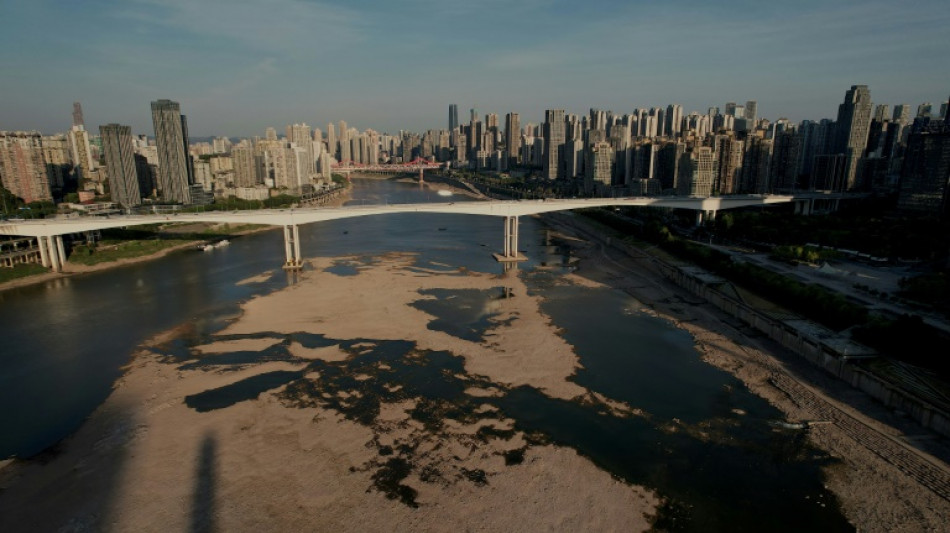
Power cuts and sleepless nights in China's record heatwave / Photo: © AFP

The lights are out along a once-bustling boulevard in a tourist spot at the epicentre of China's hottest summer on record, as people take refuge indoors from the searing heat engulfing the country's southwest.
The region is suffering through its longest continuous period of high temperatures since records began more than 60 years ago, with scientists warning such hot and dry spells will worsen as climate change warms the planet.
Temperatures as high as 45 degrees Celsius (113 Fahrenheit) have forced authorities to impose power cuts to cope with a surge in demand for electricity partly driven by people cranking up the air conditioning.
On the streets of Chongqing, a city of 30 million, locals line up for mandatory Covid tests in the wee hours of the morning, keen to avoid long queues in the scorching heat of the day.
One woman told AFP she took shelter in a local ballroom during the day -- a spot particularly busy as the elderly seek shelter from the sun and while away the hours dancing under a dimmed light.
The power shortages have now forced locals to scale back their use of air conditioning, making life a struggle.
"Since the heatwave, I feel too hot to sleep every night, and the heat wakes me up every morning," Xu Jinxin, a 20-year-old student, told AFP.
"Because of the electricity shortage, we don't leave the AC on all day," he said.
"We're trying to use less and save more, trying to use fans if we can, and life goes on with some endurance."
At Chongqing's most popular tourist spot along the Jialing River, the lights have been cut to save power and the once-busy street has gone quiet.
Locals bathe in what water remains in the dried-out riverbed and pose for photos.
The Jialing is a tributary of the mighty Yangtze -- a key node for southwestern China's trade that is now drying up, with water flow on its main trunk about 50 percent lower than the average over the last five years.
Local businesses -- already hit hard by two years of Covid-19 -- are suffering, with one bar worker saying the power shortages had affected nightlife.
"Most of the equipment like the ice-maker and the lighting in the bar are high-power machines, and the recent electricity shortage has compelled the bar to suspend business," Liu, a singer, told AFP.
Even the taps are running hot.
"In previous summers when we turned on the faucet, we might get hot water flowing for one minute, and cool water after that," said Zhang, a 25-year-old woman who did not give her first name.
"This year, even after two or three minutes, it still feels like boiling water."
burs-oho/mca/axn
(G.Khurtin--DTZ)