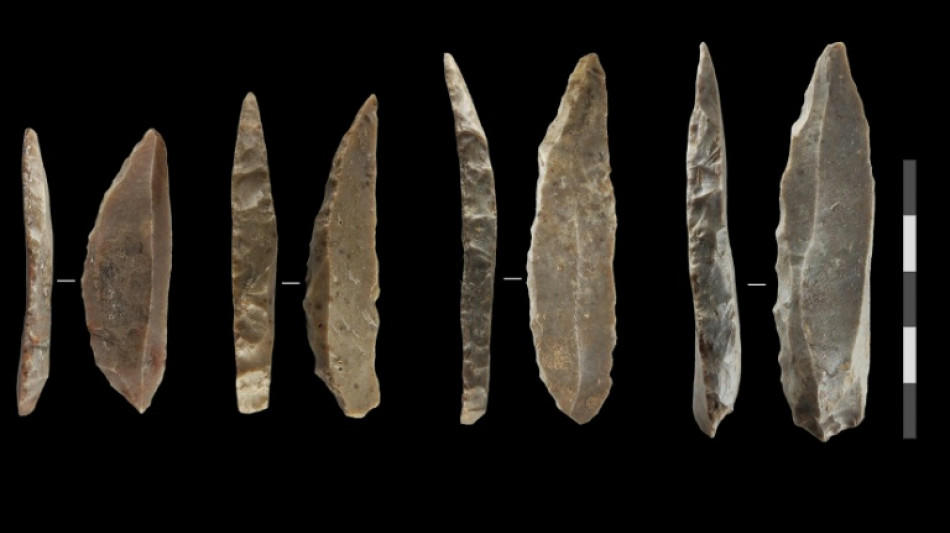
Neanderthals, humans co-existed in Europe for over 2,000 years: study / Photo: © AFP

Neanderthals and humans lived alongside each other in France and northern Spain for up to 2,900 years, modelling research suggested Thursday, giving them plenty of time to potentially learn from or even breed with each other.
While the study, published in the journal Scientific Reports, did not provide evidence that humans directly interacted with Neanderthals around 42,000 years ago, previous genetic research has shown that they must have at some point.
Research by Swedish paleogeneticist Svante Paabo, who won the medicine Nobel prize last week, helped reveal that people of European descent -- and almost everyone worldwide -- have a small percentage of Neanderthal DNA.
Igor Djakovic, a PhD student at Leiden University in the Netherlands and lead author of the new study, said we know that humans and Neanderthals "met and integrated in Europe, but we have no idea in which specific regions this actually happened".
Exactly when this happened has also proved elusive, though previous fossil evidence has suggested that modern humans and Neanderthals walked the Earth at the same time for thousands of years.
To find out more, the Leiden-led team looked at radiocarbon dating for 56 artefacts -- 28 each for Neanderthals and humans -- from 17 sites across France and northern Spain.
The artefacts included bones as well as distinctive stone knives thought to have been made by some of the last Neanderthals in the region.
The researchers then used Bayesian modelling to narrow down the potential date ranges.
- 'Never really went extinct' -
Then they used optimal linear estimation, a new modelling technique they adapted from biological conservation sciences, to get the best estimate for when the region's last Neanderthals lived.
Djakovic said the "underlying assumption" of this technique is that we are unlikely to ever discover the first or last members of an extinct species.
"For example, we'll never find the last woolly Rhino," he told AFP, adding that "our understanding is always broken up into fragments".
The modelling found that Neanderthals in the region went extinct between 40,870 and 40,457 years ago, while modern humans first appeared around 42,500 years ago.
This means the two species lived alongside each other in the region for between 1,400 and 2,900 years, the study said.
During this time there are indications of a great "diffusion of ideas" by both humans and Neanderthals, Djakovic said.
The period is "associated with substantial transformations in the way that people are producing material culture," such as tools and ornaments, he said.
There was also a "quite severe" change in the artefacts produced by Neanderthals, which started to look much more like those made by humans, he added.
Given the changes in culture and the evidence in our own genes, the new timeline could further bolster a leading theory for the end of the Neanderthals: mating with humans.
Breeding with the larger human population could have meant that, over time, Neanderthals were "effectively swallowed into our gene pool," Djakovic said.
"When you combine that with what we know now -- that most people living on Earth have Neanderthal DNA -- you could make the argument that they never really went extinct, in a certain sense."
(N.Loginovsky--DTZ)