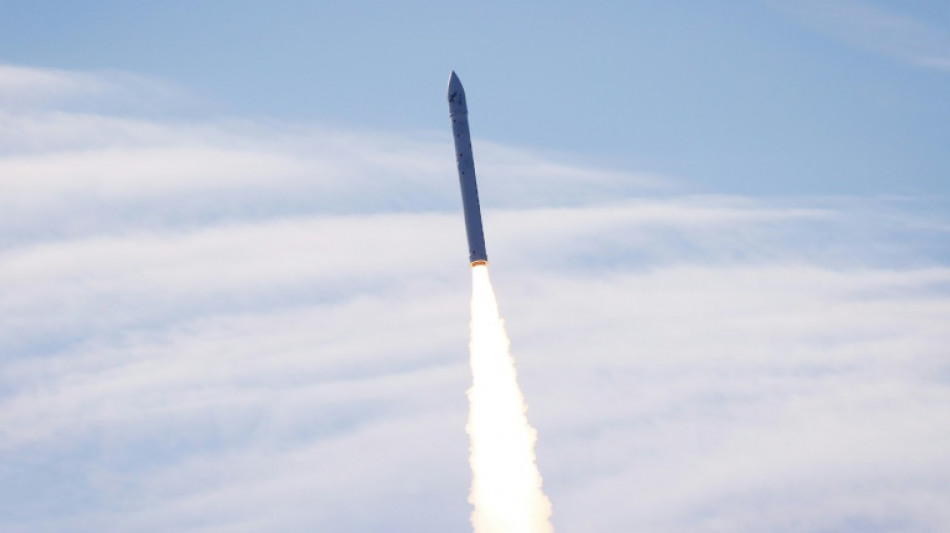
Japanese startup's space rocket launch fails / Photo: © JIJI PRESS/AFP

A space rocket built by a Japanese startup blasted off on Wednesday but was later seen spiralling downwards in the distance as the company said the launch had to be terminated.
It was the second attempt by Space One to become Japan's first private firm to put a satellite into orbit after an initial try in March ended in a mid-air explosion.
Companies such as Space One want to offer cheaper and more frequent space exploration opportunities than governments.
The startup is hoping to establish a satellite-launching service to tap into expanding global demand -- emulating Elon Musk's SpaceX, which has contracts with NASA and the Pentagon.
"We do not regard this event as a failure," Space One president Masakazu Toyoda told reporters.
"We believe that the data and experience gained... is extremely valuable and we think they will be useful for the next challenge," he said.
Company director Mamoru Endo said a glitch 80 seconds after lift-off had affected the altitude of the solid-fuel Kairos rocket.
"Our data shows that the rocket was flying in a western direction instead of the originally planned southern direction," Endo said, and it was not able to get the rocket back on course.
Space One said it hopes to launch a third Kairos rocket as soon as possible but did not give specific dates.
Spectators, gathered near the company's coastal Spaceport Kii launch pad in Japan's rural western Wakayama region, expressed their disappointment to television cameras.
"I'm so shocked," one woman said after the firm announced the failure. "I had been hoping it would go into orbit."
- Flight terminated -
News programmes showed the slim, white 18-metre (60-foot) rocket soaring far into the sky before its dizzy descent.
There was no dramatic explosion -- unlike in March when the first Kairos rocket, carrying a small government test satellite, was ordered to self-destruct due to technical problems just seconds after launch.
The latest rocket on Wednesday was carrying five satellites, including one from the Taiwan Space Agency and others designed by Japanese students and corporate ventures.
Space One, which was still investigating details of the failure, said earlier that "Kairos was launched... but the rocket terminated its flight after judging that the achievement of its mission would be difficult".
Space One was founded in 2018 by businesses including Canon Electronics, IHI Aerospace, construction firm Shimizu and the government-run Development Bank of Japan.
The Japan Aerospace Exploration Agency (JAXA) is also on a mission to become a major player for satellite launches.
JAXA's next-generation H3 launch system had experienced multiple failed take-off attempts before a successful blast-off in February.
However, JAXA had to delay the launch of a compact, solid-fuel Epsilon S rocket after a recent engine test resulted in a large fire.
(P.Vasilyevsky--DTZ)