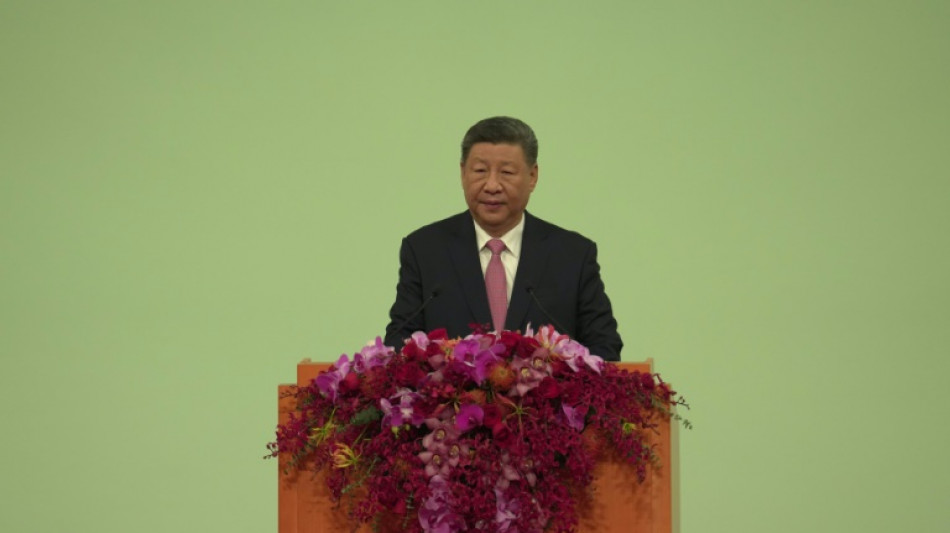
Xi says China must apply 'more proactive' macroeconomic policies in 2025 / Photo: © POOL/AFP/File

President Xi Jinping said China will put in place "more proactive" macroeconomic policies next year, state media reported, as he addressed a top political advisory body on Tuesday.
The country has struggled this year to climb out of a slump fuelled by a property market crisis, weak consumption and soaring government debt.
Beijing has unveiled a string of aggressive measures in recent months aimed at bolstering growth, including cutting interest rates, cancelling restrictions on home buying and easing the debt burden on local governments.
But economists have warned that more direct fiscal stimulus aimed at shoring up domestic consumption is needed to restore full health in China's economy.
"We must... further comprehensively deepen reform, expand high-level opening up, better coordinate development and security, (and) implement more proactive and effective macroeconomic policies," state broadcaster CCTV quoted Xi as telling the National Committee of the Chinese People's Political Consultative Conference at a New Year's tea party.
Beijing is aiming for an official national growth target this year of about five percent, a goal officials have expressed confidence in achieving but which many economists believe it will narrowly miss.
"The new quality productivity develops steadily, and annual GDP is expected to grow by about five percent," Xi reiterated on Tuesday.
The International Monetary Fund expects China's economy to grow by 4.8 percent this year and 4.5 percent next year.
- 'Near-term boost' -
Xi's comments came as Chinese authorities released optimistic factory activity figures, a sign that recent stimulus measures may be starting to take effect.
China's Purchasing Managers' Index (PMI) -- a key measure of industrial output -- was 50.1 in December, marking a third consecutive month of expansion, the National Bureau of Statistics said on Tuesday.
The figure was lower than Bloomberg analysts' prediction of 50.2, but still above 50, which indicates an expansion in manufacturing activity.
A reading below that shows a contraction.
The key indicator slid for six months in the middle of the year before returning to expansion territory in October.
The non-manufacturing PMI, which measures activity in the service sector, came in at 52.2 in December, up from 50.0 in November.
"The official PMIs suggest that the economy gained momentum in December, driven by faster growth in the services and construction sectors," Gabriel Ng of Capital Economics wrote in a note to clients Tuesday.
"Increased policy support towards the end of the year has clearly provided a near-term boost to growth," Ng wrote.
Ng noted that export orders in particular rose to a four-month high in December, "probably helped by US importers ramping up orders in advance of potential Trump tariffs".
(L.Møller--DTZ)