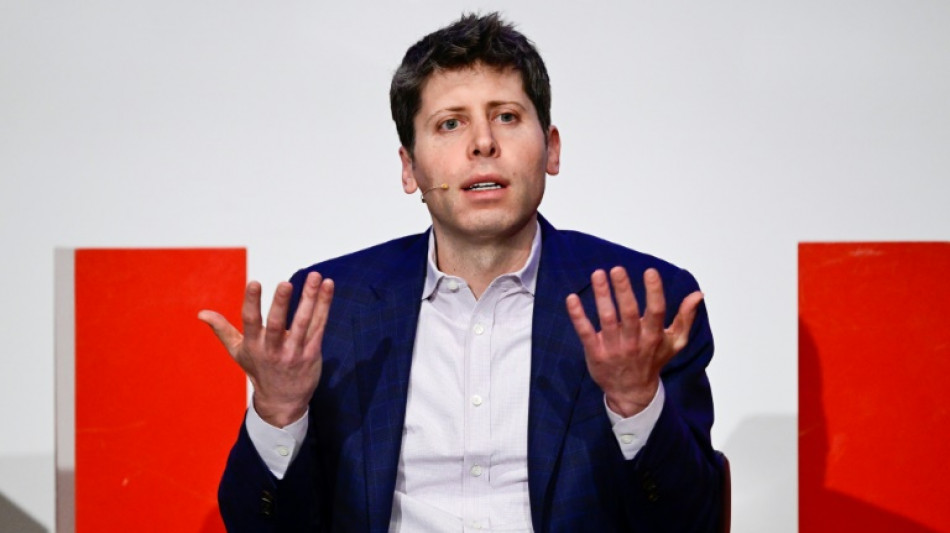
OpenAI says it raised $40 bn at valuation of $300 bn / Photo: © AFP

OpenAI on Monday said it raised $40 billion in a new funding round that valued the ChatGPT maker at $300 billion, the biggest capital-raising session ever for a startup.
The infusion of cash comes in a partnership with Japanese investment giant SoftBank Group and "enables us to push the frontiers of AI research even further," the San Francisco-based company said in a post on its website.
"Their support will help us continue building AI systems that drive scientific discovery, enable personalized education, enhance human creativity, and pave the way toward AGI (artificial general intelligence) that benefits all of humanity," the company said.
AGI refers to a computing platform with human-level intelligence.
The company plans to scale its infrastructure and "deliver increasingly powerful tools for the 500 million people who use ChatGPT every week."
- Opening up? -
The funding news came the same day OpenAI announced it was building a more open generative AI model as it faces growing competition in the open-source space from Chinese rival DeepSeek, and Meta.
The move would mark a strategic shift by OpenAI, which until now has been a fierce defender of closed, proprietary models that do not allow developers to modify the basic technology to make AI more adapted to their goals.
OpenAI and defenders of closed models -- which include Google -- have often decried open models as riskier and more vulnerable to nefarious uses by malicious actors or non-US governments.
OpenAI's embrace of closed models has also been a bone of contention in its battles with former investor Elon Musk, the world's wealthiest person, who has called on OpenAI to honor the spirit of the company's name and "return to the open-source, safety-focused force for good it once was."
Putting pressure on OpenAI, many large companies and governments have proved reluctant to build their AI products or services on models they have no control over, especially when data security is a concern.
The core selling point of Meta's family of Llama models or DeepSeek's models is addressing these worries by letting companies download their models and have far greater control to modify the technology for their own purposes and keep control of their data.
Meta CEO Mark Zuckerberg said earlier this month that Llama hit one billion downloads, while the release of DeepSeek's lower-cost R1 model in January rocked the world of artificial intelligence.
"We've been thinking about this for a long time, but other priorities took precedence. Now it feels important to do," OpenAI chief executive Sam Altman said on X of the decision to build a more open model.
OpenAI has been riding on the success of its latest image-generation features in ChatGPT, the world-leading AI app and chatbot.
Altman posted on Monday that the tool helped add "one million users" in one hour.
That claim came days after Altman said the new image features were so popular that they were melting the OpenAI graphics processing units that power the AI due to heavy use.
(S.A.Dudajev--DTZ)