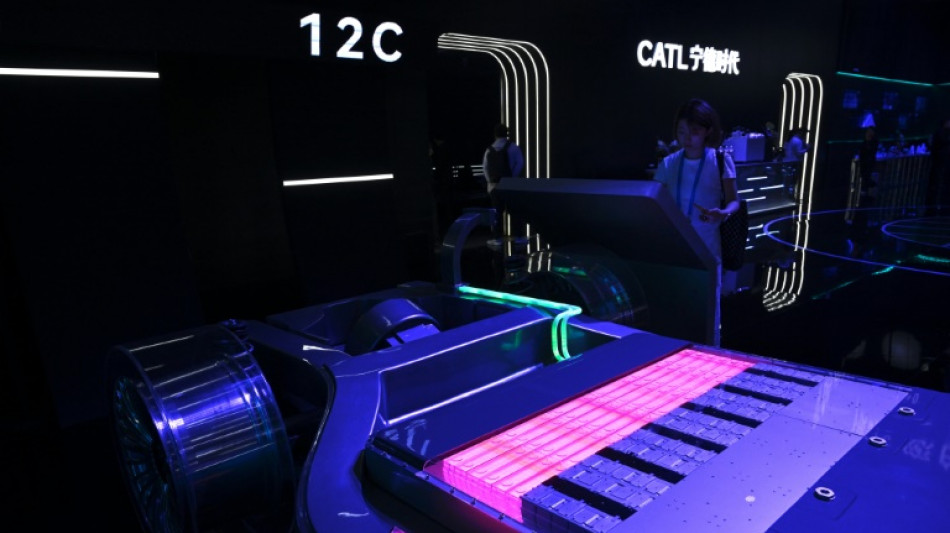
China's CATL launches new EV sodium battery / Photo: © AFP

Chinese battery giant CATL launched on Monday a new sodium-ion battery it says will restructure the electric car industry, and a new system to combine two battery technologies into one car.
The firm produces more than a third of all electric vehicle (EV) batteries sold worldwide, working with major brands including Tesla, Mercedes-Benz, BMW and Volkswagen.
Sodium-ion batteries are viewed as a cheaper and in some respects safer alternative to the lithium-ion batteries which are widely used in both electronics and electric vehicles but pose a fire risk if damaged.
"We will achieve mass production by the end of the year. It will restructure the whole industry," CATL's chief marketing officer Luo Jian told a news conference in Shanghai on Monday.
Production of the sodium-ion batteries is due to start in June, beginning with small starter batteries for heavy goods vehicles under the Naxtra brand. This new battery is expected to offer a major advantage for starting vehicles in cold weather.
Production of large batteries for electric and hybrid cars are due to follow in December of this year.
The sodium-ion batteries have "emerged from the labs and are now ready for commercial scale production", CATL CEO Robin Zeng told the news conference.
Zeng said he sees sodium-ion batteries replacing half the market for lithium, iron and phosphate batteries.
While sodium-ion technology has been around for decades, it has lagged behind lithium-ion batteries in performance. But renewed interest in the technology has meant sodium-ion batteries can be manufactured without the need for certain costly metals.
CATL's Naxtra batteries promise a driving range of 500 kilometres (310 miles) for electric cars.
A few hours before the opening of the Shanghai Motor Show on Monday, CATL also launched the second generation of its Shenxing battery, due to be fitted in 67 cars this year belonging to Chinese brands Zeekr, Nio and Avatr.
The fast-charging battery boasts an 800-kilometre driving range, and a 520-kilometre range regained in just five minutes of charging time -- more than its Chinese rival BYD.
CATL is counting on the development of battery exchange systems, such as that of its partner Nio, to disseminate its new technologies.
But heavy tariffs imposed by US President Donald Trump on China could increase the price of parts and cars.
CATL executives declined to comment on tariffs.
The US Defense Department has included CATL on a list of companies it accuses of affiliation with the Chinese military, a claim denied by CATL.
At the Shanghai Motor Show, the group also presented as its new dual battery system for EVs.
The firm's technical director Gao Huan said the dual system will offer more safety, particularly for self-driving cars, by preventing failure if one of the two batteries malfunctions.
A production date for the dual batteries, which have been in development for five years, has yet to be announced. But one car manufacturer is already using the dual system in its design of an autonomous car, Gao said.
stsz-ew/ak/dhw/dw
(W.Uljanov--DTZ)