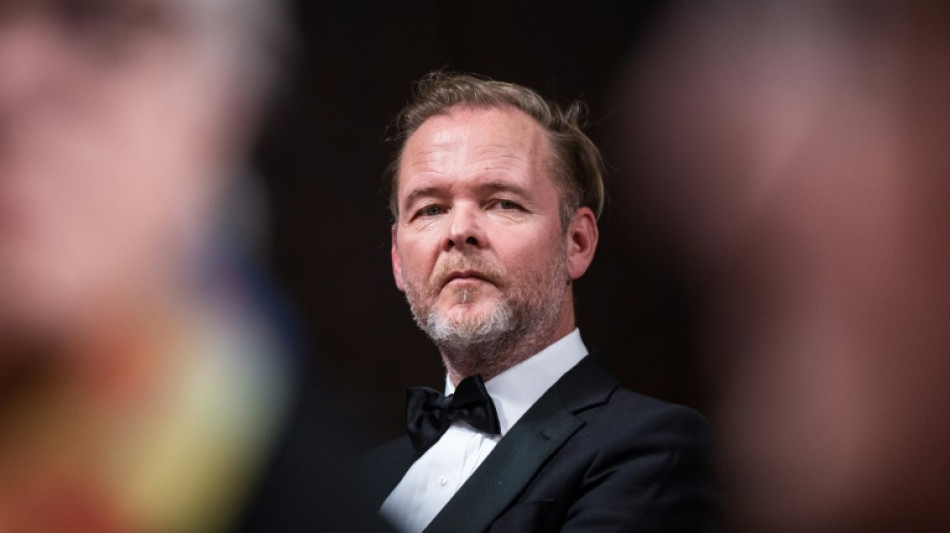
Nobel literature buzz tips Swiss postmodernist, Australians for prize / Photo: © AFP/File

Swiss postmodernist novelist Christian Kracht and Australia's Gerald Murnane and Alexis Wright are among the favourites for the Nobel literature prize, experts told AFP ahead of the Swedish Academy's much-anticipated announcement on Thursday.
The academy made history last year by choosing South Korea's Han Kang, making her the first Asian woman to win the prize.
But this year several experts predicted the winner would likely be a man -- and European to boot.
"I could see it going to a European man -- that the Academy could do that with a clear conscience because they chose a non-European woman last year," Sveriges Radio culture critic Lina Kalmteg told AFP.
Kracht, Hungary's Laszlo Krasznahorkai and Peter Nadas, and Romania's Mircea Cartarescu are among those whose names are making the rounds.
Kracht, a 58-year-old German-language postmodernist author who writes about pop culture and consumerism, is a favourite in literary circles, Bjorn Wiman, culture editor at Swedish paper of reference Dagens Nyheter, told AFP.
At this year's Gothenburg Book Fair held annually a few weeks before the Nobel announcement, "many members of the Swedish Academy were there, sitting in the front row during his event", Wiman said.
"And that is usually a sure sign," he said, adding that the same thing happened when Austrian playwright Elfriede Jelinek won the prize in 2004.
- 'Unthinkable' -
Since it was first awarded in 1901, the Nobel literature prize has been dominated by Western male writers.
There are only 18 women among the 121 laureates, and only very few prizewinners have bodies of work written in Asian or Middle Eastern languages. No African languages are represented.
A 2018 #MeToo scandal left the Academy in tatters, and more than half of its members ended up being replaced.
The institution promised to broaden the prize, both geographically and linguistically, and since then, there has been a more even gender balance among laureates.
Since 2018, every other laureate has been a woman.
"Authors like Han Kang would have been unthinkable five or six years ago," Wiman said, noting that the Academy previously tended to honour older men and she was only 53 when she won.
But, Wiman said, he also thinks this year the award would likely go to a man "from the Anglo-Saxon, German or French-language world".
Kalmteg said that the list of previous laureates shows a pattern of sorts: "it's kind of 'OK, this year was a European, now we can look a little further afield. And now we go back to Europe. Last year was a woman, let's choose a man this year.'"
- 'Bizarre masterpiece' -
But with no public shortlist and the prize committee's deliberations sealed for 50 years, it is always difficult to predict which way the 18-member Swedish Academy is leaning.
Others regularly mentioned in the run-up to the Nobel are Canada's Anne Carson, Chile's Raul Zurita, India's Amitav Ghosh and Argentina's Cesar Aira.
The last South American to win the Nobel was Peru's Mario Vargas Llosa in 2010, and the region could be overdue, Kalmteg told AFP.
She also named Mexican author Cristina Rivera Garza as a possibility.
The Academy does have a penchant for shining a spotlight on writers relatively unknown to a wider public, regardless of their race or gender.
Among possible winners frequently mentioned this year are Australia's Gerald Murnane and his Aboriginal colleague Alexis Wright.
Born in 1939 in Melbourne, Murnane describes his work as "literary fiction" that comprises "the contents of my mind".
In his first book "Tamarisk Row" (1974), he wrote about his father's gambling, his mother's religion and his schoolfellows' cruelty.
His novel "The Plains" (1982) delves into Australian landowners' culture, described by the New Yorker as a "bizarre masterpiece" that feels more like a dream than a book.
"The question is whether he'll answer the phone (when the Academy calls), I don't know if he even has one," joked Josefin de Gregorio, literary critic at Sweden's other main daily SvD.
"He's never left Australia. He lives in the countryside, he doesn't make himself very accessible," she said of her favourite author.
"I hope he wins, I want more people to discover his wonderful work," de Gregorio said, adding that she would also be happy to see American short story writer George Saunders get the nod.
The 2025 winner, who will take home a $1.2 million cheque, will be announced on Thursday at 1:00 pm (1100 GMT).
(I.Beryonev--DTZ)