Deutsche Tageszeitung - 'Historic day': Artemis astronauts break space distance record

'Historic day': Artemis astronauts break space distance record


'Historic day': Artemis astronauts break space distance record
'Historic day': Artemis astronauts break space distance record / Photo: © NASA/AFP

The four astronauts embarking on NASA's lunar flyby became on Monday the humans to travel furthest from our planet, as they get set to view areas of the Moon never before seen by the naked eye.

Change text size:

The Artemis II team broke the previous record set by 1970's Apollo 13 mission, which they are expected to surpass by approximately 4,105 miles (6,606 kilometers) when they reach this journey's furthest distance from Earth -- 252,760 miles (406,778 kilometers) -- later today.

The astronauts are journeying around the Moon for a monumental flyby, in which they'll spend more than six hours analyzing and documenting lunar surface features.

The NASA mission had swept earlier into the Moon's gravitational sphere of influence, meaning their spacecraft is in the natural satellite's neighborhood, with lunar gravity outmuscling Earth's pull.

The Orion capsule is zipping around the Moon before U-turning and heading back to Earth in a so-called "free-return trajectory," a return-trip that will take about four days.

The astronauts began their landmark day with a message from the late Jim Lovell, who took part in the Apollo 8 and 13 missions and recorded the message shortly before his death.

"It's a historic day, and I know how busy you'll be, but don't forget to enjoy the view," the Artemis astronauts heard from Lovell.

"Welcome to my old neighborhood," he said. "I'm proud to pass that torch on to you as you swing around the Moon."

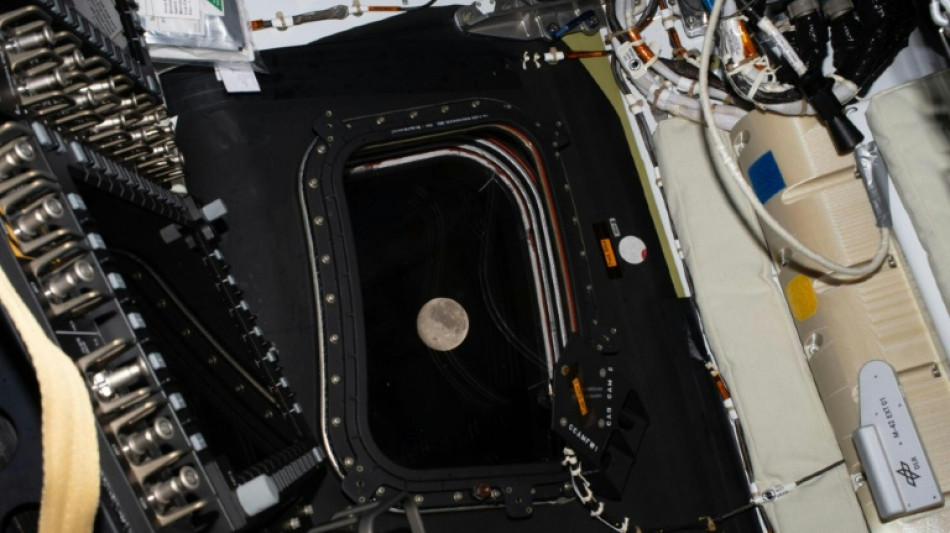
Swooping around the far side of the Moon, the crew of four will witness previously hidden lunar territory -- the sphere looming large through their capsule windows.

The Moon will appear to the astronauts "about the size of a basketball held at arm's length," Noah Petro, head of the US space agency's planetary geology lab, told AFP.

Adding to the historic nature of the mission led by Reid Wiseman, the Artemis II crew includes several firsts.

Victor Glover will be the first person of color to fly around the Moon, Christina Koch will be the first woman, and Canadian Jeremy Hansen the first non-American.

There will be a period of around 40 minutes during the flyby where all communication with Artemis II will be cut off as the astronauts pass behind the Moon.

"It'll be exciting, you know, in a slightly scary way, when they go behind the moon," Derek Buzasi, a professor of astronomy and astrophysics at the University of Chicago, told AFP.

- Human eye vs camera -

The astronauts have already started seeing features never previously glimpsed directly.

An image sent back by the crew showed the Moon's Orientale basin visible, a massive crater that before had only been viewed by orbiting, uncrewed cameras.

Near the end of their flyby, the astronauts will witness a solar eclipse, when the Sun will be behind the Moon.

Despite the technological advancements since the Apollo era, NASA still relies on the eyesight of its astronauts to learn more about the Moon.

"The human eye is basically the best camera that could ever or will ever exist," Kelsey Young, the lead scientist for the Artemis II mission, told AFP. "The number of receptors in the human eye far outweighs what a camera is able to do."

And while the Orion crew will still be at a substantial distance from the Moon, their flyby is key to preparing for a later crewed mission to the planet's surface itself.

"We're going to learn an awful lot about the spacecraft," NASA administrator Jared Isaacman told CNN on Sunday.

The information will be "pretty paramount to set up for subsequent missions like Artemis III in 2027 and, of course, the lunar landing itself on Artemis IV in 2028," he added.

(T.W.Lukyanenko--DTZ)

Featured

Lunar crater named after Artemis commander's deceased wife

Artemis astronauts at the outer edge of human space travel had an emotional moment Monday as they named a crater in honor of the deceased wife of mission commander Reid Wiseman.

New frontier: Artemis astronauts break space distance record

The four astronauts embarking on NASA's lunar flyby became on Monday the humans to travel furthest from our planet, as they begin documenting areas of the Moon never before seen by the naked eye.

Giant step for humankind: Artemis crew to set space distance record

Four Artemis II astronauts are taking a giant step for humankind Monday when they shoot deeper into space than anyone before and glimpse parts of the Moon never seen by the naked eye.

Saving energy in everyday life or a complete rip-off?

Global energy supply has been tightened by the Middle East conflict. Before the latest war, about 20 % of the world’s oil moved through the Strait of Hormuz. Fighting has throttled this shipping corridor and sent Brent crude prices soaring by 59 % to $115.66 per barrel in March 2026. The International Energy Agency (IEA) responded by releasing 400 million barrels from strategic reserves, the largest draw in its history. Liquefied natural gas deliveries to Europe have also fallen sharply, increasing the risk of shortages.Countries have adopted emergency measures. South Korea has said it could extend driving restrictions beyond public institutions if crude rises to $120–130 per barrel. Nigeria’s petrol prices have jumped 65 %, prompting tax breaks and fuel rationing. Ethiopia’s state-owned engineering group told staff to switch to virtual meetings to save fuel. Sri Lanka has cut its work week to four days, and the Philippines declared a national energy emergency.IEA recommendations and policy responses - the IEA proposes ten measures aimed at reducing demand in the short term. Key recommendations include:- Work from home – remote work where possible to reduce commuting.- Lower speed limits – cutting highway speeds by at least 10 km/h to save fuel.- Avoid air travel – opt for trains or buses for shorter trips.- Accelerate energy-efficiency upgrades – insulate buildings better and modernize heating systems.- Invest in renewable energy – expand solar and wind power, deploy heat pumps and electrify transport.Governments are combining these measures with rationing. Indonesia plans to impose driving restrictions and price controls. Fuel tax cuts and subsidies are being used to cushion households in many countries. Meanwhile, workers and businesses are demanding structural reforms to ensure long-term energy security.Situation in GermanyGermany has past experience with saving energy. During the 2022 gas crisis, households cut gas consumption by 20 % and electricity use by 6–7 %. Nevertheless, gas storage levels were only 22.27 % full in April 2026 and need to reach 80 % before winter. Oil reserves cover about three months of imports. Experts like Martin Pehnt urge investment in insulation, heat pumps, solar power and industrial decarbonization to reduce fossil-fuel dependence.Surveys show a mixed public response. An ista poll found that 69 % of participants save energy to reduce costs, yet nearly half plan to maintain their current consumption. A survey by Hansgrohe/YouGov reported that 69 % of respondents are willing to shorten their showers or lower the water temperature, but only 32 % actually reduce temperature. Some 72 % oppose government mandates to save water. Willingness to save energy varies widely across age groups and regions. The question that citizens in Germany keep asking media representatives is: "Why are the prices of petrol, diesel and energy so high? Is it a brazen, pure rip-off by the state, perpetrated by completely incompetent politicians, or what are the reasons?"

Change text size: