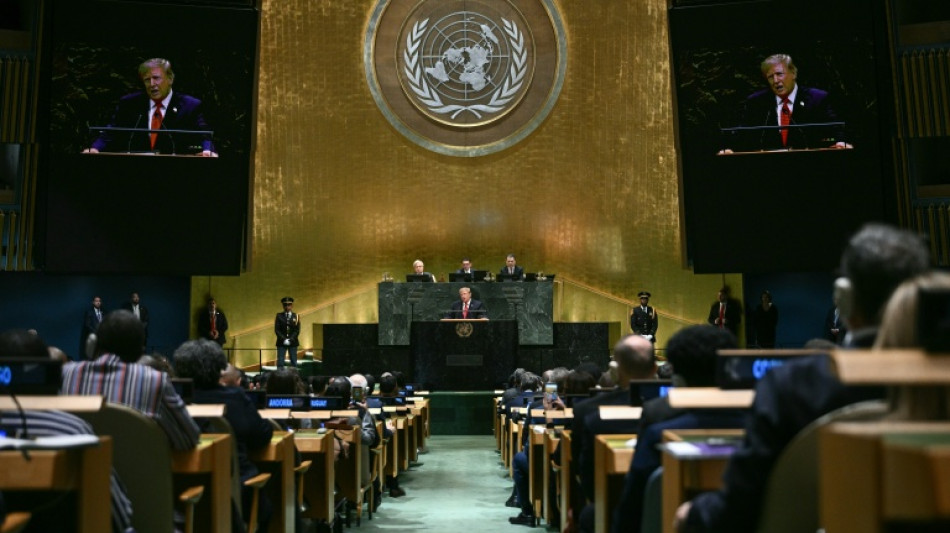
Trump renames AI "super intelligence," rejects international oversight / Photo: © POOL/AFP

US President Donald Trump on Tuesday announced that the US government would rename artificial intelligence "super intelligence" in official communications, as he firmly rejected calls for international supervision of AI, calling them a "globalist scheme" to control the new technology.
Speaking to the United Nations General Assembly, Trump argued the word "artificial" undersold the technology and voiced hope the rest of the world would adopt the new term.
"It sounds much better. It is much better, and it's much more accurate," he said.
The rebrand is the latest in a series of renamings pursued by the Trump administration, which changed the Gulf of Mexico to the "Gulf of America" via executive order last year and, in August, renamed Lake Ontario "Lake America" amid a trade dispute with Canada.
Trump has also floated renaming the Atlantic or Pacific oceans.
In his speech, Trump dismissed warnings from AI safety advocates, comparing them to warnings about climate change, whose human causes are affirmed by the overwhelming consensus of the scientific community.
"The United States totally rejects any attempt to construct a globalist scheme to control... artificial intelligence," he said.
"Every major new technology brings challenges, and superintelligence is no exception," he added.
"The very same people who said we'll all be dead in 12 years because of global warming... are now saying that AI is going to kill us all, that robots are going to attack us, and that everything is going to be a total disaster."
Ahead of the week of meetings and speeches in New York, leaders of more than 20 mostly European countries urged binding safety measures for advanced artificial intelligence, warning that the technology's development could outpace the ability to control it.
AI superpowers China and the United States did not endorse the idea.
The AI companies themselves are increasingly asking for global coordination on AI safety, with OpenAI's Sam Altman set to address the UN Security Council on Wednesday.
Anthropic chief Dario Amodei and Hugging Face co-founder Clement Delangue will also participate remotely, a French official said Tuesday.
France, which holds the Security Council presidency this month, initiated the meeting and believes AI's threat to international peace and security has not been sufficiently discussed at the council level.
UN chief Antonio Guterres, meanwhile, called for the US and China to start a dialogue on the technology's future akin to US-Soviet engagement at the height of the Cold War.
"Governments with the greatest AI capabilities have the greatest responsibilities to humanity, to establish channels for dialogue, transparency, trust and cooperation," Guterres said in his address to the assembly.
"At a pivotal moment during the Cold War, strategic rivals came to recognize the need to manage shared existential risks."
China and the US are currently discussing creating a communication channel for AI concerns in anticipation of a Washington summit meeting between Trump and Chinese President Xi Jinping on Thursday.
Both powers confront rising fears that increasingly capable artificial intelligence systems could eventually escape human control, even as they race for technological supremacy.
(M.Dylatov--DTZ)