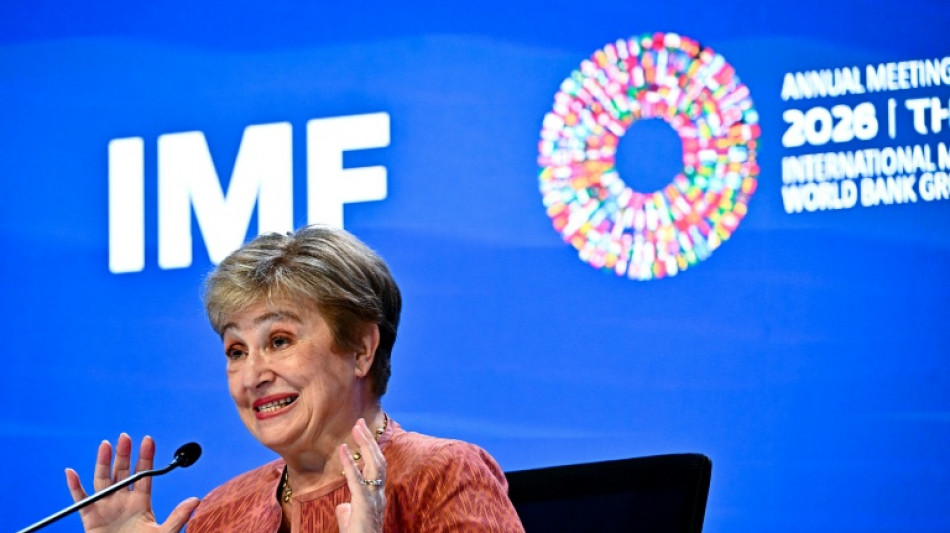
IMF chief flags 'optimism', 'worry' after Bangkok annual meetings / Photo: © AFP

International Monetary Fund chief Kristalina Georgieva said on Saturday this year's Annual Meetings with global policymakers were marked by "optimism and worry" about the global economic outlook as the event wound down in Bangkok.
Georgieva also said her organisation had a "responsibility" to help low-income countries struggling with price shocks stemming from the US-Israel war on Iran.
Meetings in the Thai capital this week brought together finance ministers, central bank chiefs and other top officials from around the world, with surging inflation, spiking bond yields and economic growth driven by artificial intelligence at the top of the agenda.
"(The meetings) were marked by both optimism and worry," said Georgieva, who was speaking at a press briefing alongside Saudi Finance Minister Mohammed al-Jadaan.
"Optimism from the resilience of the global economy, the promise of AI, the dynamism of Asia. But AI is also recognised to be a source of worry, and so are inflation, high levels of debt, wars, climate risks."
All week, the IMF has warned that high levels of debt and rising bond yields in advanced economies are tightening financial conditions just as central banks need to focus on bringing inflation down, likely by increasing interest rates.
Global energy prices have spiked since late February, when the United States and Israel launched the war on Iran, with Tehran's retaliatory actions targeting Washington's Gulf allies and curtailing oil and gas supplies.
The price increases have rippled across the globe, fuelling inflation in economies across a range of income groups.
The most vulnerable to the shock, the IMF has said, are low-income oil-importing countries that are not exposed to the boom in AI investment that has propped up growth in many advanced economies.
"I can tell you that people everywhere, but especially in poorer countries, they don't like inflation. Inflation is like a tax on the poor," said Georgieva.
She said such countries needed to set spending targets such that they prioritised growth and protecting the most vulnerable people, adding that the Fund had a "relentless pursuit of more resources for low-income countries".
Higher global interest rates and bond yields, however, were driving up debt repayments for low-income countries, she said.
The share of debt repayments as a percentage of government revenue had gone up from eight to 14 percent for low-income countries in recent years, the IMF chief said.
She said her organisation had a responsibility to help countries to restructure debt if needed; to assist with domestic resource mobilisation; to bring in international finance; and to create conditions for private investment.
"When we do our best, it translates into better lives for people."
On the AI investment boom, Georgieva said that member countries had recognised its value in propping up growth, but "when we are dependent on one particular driver of growth, it is like we stand on one leg".
A key debate at this year's meetings has been on whether the technology's most advanced frontier models require regulation and guardrails.
The question has grown more urgent after recent revelations of security incidents involving autonomous AI agents.
Georgieva said she was "impressed" by the spirit of cooperation between AI companies, governments and other stakeholders that she witnessed in Bangkok on the issue.
(W.Budayev--DTZ)