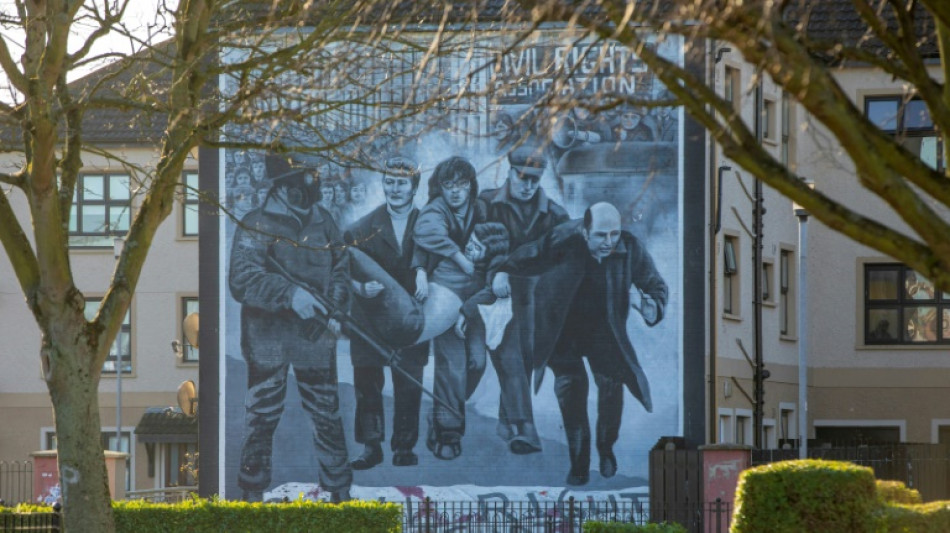
'Bloody Sunday': 10 minutes of killing that shook N.Ireland

"Bloody Sunday" was a turning point in three decades of violence in Northern Ireland known as the "Troubles".
On Sunday January 30, 1972, British paratroopers shot dead 13 Catholic demonstrators in the province's second city, Londonderry.
Here is how events unfolded:
- Peaceful march -
The Northern Ireland Civil Rights Association (NICRA) organised an anti-internment march to take place that day in the city Catholics call Derry.
They were angry at the increasing internment without trial of Catholic nationalists since the previous August.
The march was illegal. Northern Ireland's Protestant authorities had declared a year-long ban on all marches amid spiralling unrest since civil rights protesters began demanding an end to voting, housing and job discrimination against the minority Catholic community in 1968.
Nevertheless, at least 15,000 people joined the march, which set off in a carnival-like mood from the Creggan Estate, a few kilometres from the city centre, through the Catholic Bogside district to Guildhall Square.
Crack troops from the British 1st Battalion Parachute Regiment, drafted in that day, were waiting at barricades to stop the march reaching the city centre.
- Confrontation -
A section of the crowd turned into William Street and youths began throwing stones at a British army barricade.
Troops were ordered to begin arrests and armoured cars drove into the crowd.
Around 4:10 pm soldiers started firing.
Within about 10 minutes 13 people were dead and a further 15 injured. Six of the dead were aged 17.
- 'Whitewash' -
The troops claimed to have come under sustained gunfire as well as attacks with nail bombs. They said they aimed away from the demonstrators.
Their claims, largely accepted in the official report by senior English judge John Widgery, published later that year, were not backed up by independent accounts.
No soldiers were injured in the operation and no guns or bombs recovered.
The victims' families derided the report as a "whitewash".
- Explosion in violence -
The killings proved a boon to the nascent Provisional Irish Republican Army, fighting for Northern Ireland's reunification with Ireland, whose ranks swelled with new recruits.
On February 2, an angry crowd set fire to the British embassy in Dublin.
On March 24, London suspended the Protestant-dominated Northern Ireland provincial government, leading to decades of direct rule from the British capital.
- Apology -
In June 2010 a new report published after a 12-year investigation said British troops fired first and had given misleading accounts of what happened.
The report by senior British judge Mark Saville concluded that none of the victims was armed, soldiers gave no warnings before opening fire and the shootings were a "catastrophe" for Northern Ireland and led to increased violence.
Following the report then British prime minister David Cameron apologised for the killings, saying: "There is no doubt... what happened on 'Bloody Sunday' was both unjustified and unjustifiable. It was wrong."
- Ex-soldier charged -
On March 14, 2018 an ex-paratrooper, known only as Soldier F, was charged with murdering two people and the attempted murder of four others.
But the charges were dropped in July 2021 after a backlash by MPs from Britain's ruling Conservative Party.
"Bloody Sunday", immortalised by a song by Irish rock group U2, was one of the darkest episodes in the conflict between Northern Ireland's Catholic nationalists -- who want a united Ireland -- and Protestant unionists loyal to Britain.
(N.Loginovsky--DTZ)