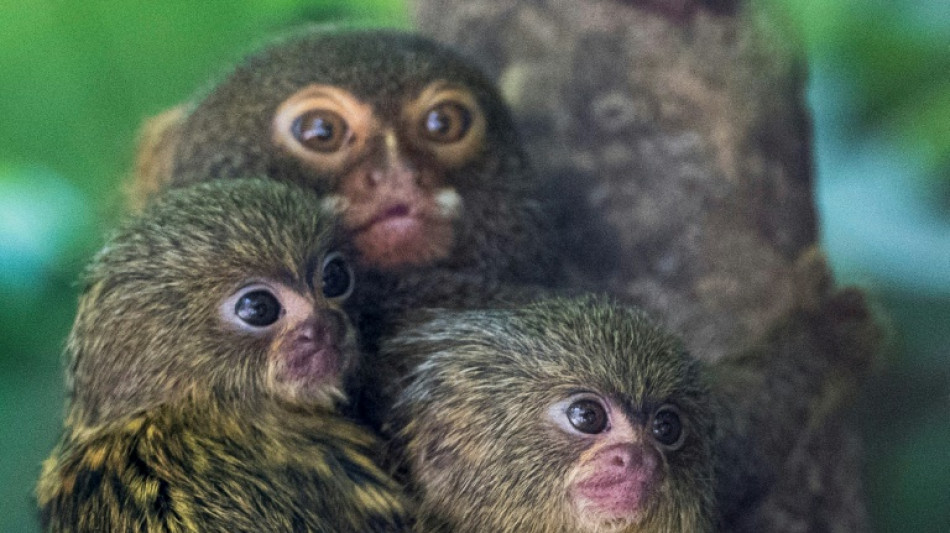
Monkey monikers: Like humans, marmosets give each other names / Photo: © AFP/File

Naming others is considered a marker of highly advanced cognition in social animals, previously observed only in humans, bottlenose dolphins and African elephants.
Marmoset monkeys have now joined this exclusive club, according to a new study published in Science on Thursday.
The diminutive primates use loud, high-pitched calls to assign each other "vocal labels," as shown in research conducted by a team at the Hebrew University of Jerusalem.
"We are very interested in social behavior because we think that social behavior is essentially what drove us humans to be so special compared to other animals," senior author David Omer told AFP.
"We don't run fast, we don't fly, we don't excel in anything else besides being social and all our achievements as a society are our societal achievements."
Marmosets are ideal subjects to study the evolution of social behavior and language in humans, he explained, because they exhibit similar traits, living in small monogamous family groups of six to eight individuals that cooperatively rear their young.
Led by graduate student Guy Oren, the researchers recorded natural conversations between pairs of marmosets separated by a visual barrier, as well as interactions between the monkeys and a computer system that played back pre-recorded calls.
They discovered that marmosets use "phee calls" -- very high-pitched vocalizations, as loud as power tools -- to address one another. Notably, the monkeys could recognize when such calls were directed at them and were more likely to respond when addressed by their name.
- Machine learning advances -
The ten marmosets they tested came from three separate families, and the research also revealed that members within a family group used similar sound features to code different names, akin to dialects or accents in humans. This held true even for adult marmosets that weren't related by blood, suggesting they learned from others within the family group.
Marmosets are relatively distant relatives of humans. We last shared a common ancestor around 35 million years ago, while the split between ourselves and chimpanzees could have happened 5-7 million years ago.
Rather than genetic proximity, Omer attributes the acquisition of vocal labels by marmosets to "convergent evolution," or the idea that they evolved similar traits in response to comparable environmental challenges.
For marmosets, vocal labeling may have been crucial for maintaining social bonds and group cohesion in the dense rainforests of South America, where visibility is often limited.
How and when humans first began talking is a matter of debate, but until recently many scientists had dismissed the idea we could look to other primates for clues. Omer stressed the latest research was yet another blow to that long-standing opinion.
"We can still learn a lot from non-human primates about the evolution of language in humans," he said.
The team's statistical analysis of the marmosets' calls was made possible by recent advancements in computational power and machine learning, he added. Looking ahead, one exciting avenue for future research could be leveraging AI to further decipher the content of marmoset conversations.
(Y.Ignatiev--DTZ)