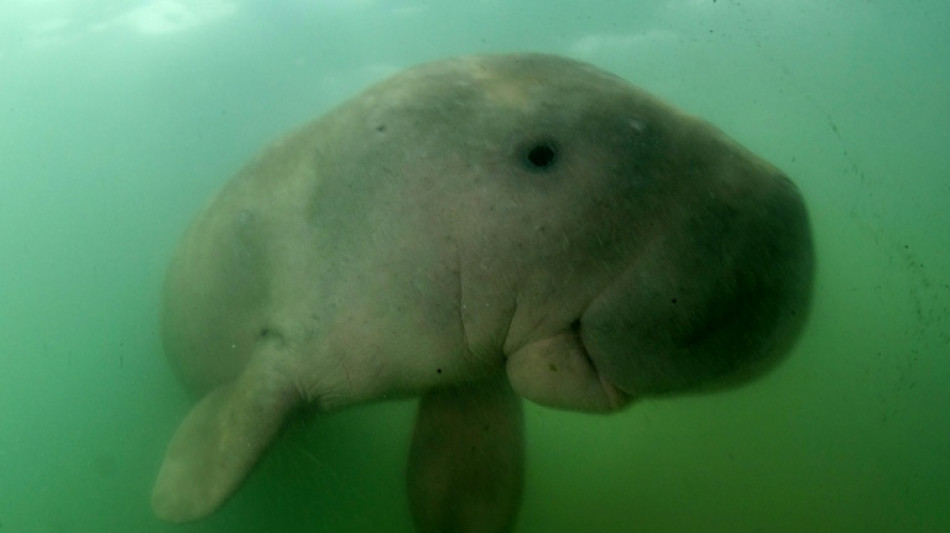
War threatens Gulf's dugongs, turtles and birds / Photo: © AFP/File

From sea turtles to birds and the gentle dugong, the Persian Gulf's diverse but fragile marine life is threatened by the bombs and oil of the war in the Middle East.
The ecosystem was already under pressure from climate change and maritime traffic before the United States and Israel launched their war on Iran at the end of February, leading to Tehran's region-wide retaliation.
More than 300 incidents involving environmental risks -- including attacks on oil tankers -- have been recorded in the region since the conflict broke out, according to a March 10 report by the Conflict and Environment Observatory, a UK non-governmental organisation.
The geography of the Gulf makes its ecosystem particularly vulnerable.
A semi-enclosed and shallow sea about 50 metres (165 feet) deep on average, it is connected to the Indian Ocean through the Strait of Hormuz. Its slow water renewal -- every two to five years -- limits the dispersion of oil or other pollutants.
The region hosts the world's second-largest population of dugongs -- herbivorous marine mammals known as "sea cows" that are listed as vulnerable -- with an estimated 5,000 to 7,500 individuals.
About a dozen species of marine mammals are also found there, including humpback whales and whale sharks.
In total, more than 2,000 marine species have been recorded in the warm Gulf waters, including over 500 fish species and five types of sea turtles, among them the critically endangered hawksbill sea turtle.
There are also about 100 species of corals which, together with mangroves and seagrass beds, form essential breeding and nursery grounds for fish and crustaceans.
- 'Time bomb' -
Greenpeace warned last week that dozens of tankers carrying around 21 billion litres (5.5 billion gallons) of oil were trapped in the Persian Gulf.
"This is an ecological ticking time bomb," said Nina Noelle, of Greenpeace Germany, who has been mapping oil tankers in the region.
Since March 1, nine incidents involving oil tankers, including attacks,have been reported to the United Kingdom Maritime Trade Operations centre (UKMTO), eight of which were later confirmed by the International Maritime Organization (IMO).
Three additional attacks were claimed by Iran's Islamic Revolutionary Guard Corps, though these have not been confirmed by international bodies.
On land, Iran's Foreign Minister Abbas Araghchi said Monday that Israeli strikes on Tehran fuel depots constituted "ecocide", contaminating soil and groundwater and causing long-term risks to people's health.
- Past experiences -
"The wars in the 1980s and 1990s demonstrate how exposed the ecosystems of the Persian Gulf are to conflict pollution, whether this is from damage to on- or offshore oil facilities or through spills from attacks on shipping," CEOBS director Doug Weir told AFP.
The Gulf War in 1991 triggered one of the largest marine oil spills linked to armed conflict, when retreating Iraqi forces deliberately opened oil valves in Kuwait and destroyed oil infrastructure.
It took decades to recover: up to 11 million barrels of oil (1.75 billion litres) were released, contaminating 640 kilometres of Saudi coastline and killing more than 30,000 seabirds, according to several studies.
The studies, however, "largely showed minimal impacts on coral reefs", said John Burt, biology professor at the Mubadala Arabian Center for Climate and Environmental Sciences at New York University Abu Dhabi.
"This is largely because oil floats, so the dispersal of oil remains on the surface and doesn't really interact with corals except in the most shallow areas," Burt said.
"However, the same cannot be said for intertidal systems" such as salt marshes and mudflats that line the coast and are exposed at low tide, he added.
"Here, oil spills can have significant and medium-term impacts, if the spills become coastal," Burt said.
Seabirds are especially at risk because oil destroyed the waterproofing of their feathers, leading to hypothermia and drowning.
- Bomb noise -
Bombs are also a threat to the area's birds.
Their migration could be disrupted by the noise of explosions and by plumes of toxic smoke, as the Arabian Peninsula sits at the crossroads of major migratory routes linking Europe, Central Asia, Africa and South Asia.
"Sea mines and other explosive devices can cause acoustic disturbance impacting sea mammals and other animals, and blast damage to natural undersea structures such as reefs," Weir said.
In 2003 and 2020, two studies published in Nature and in a journal of the Royal Society found links between the use of mid-frequency military sonar and whale strandings.
(P.Tomczyk--DTZ)