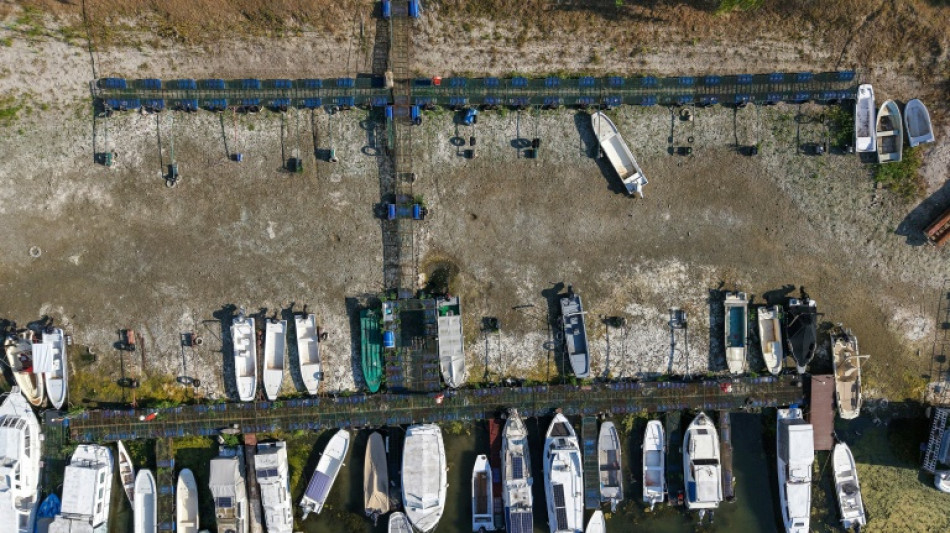
Danube drops to 'historic lows' as fresh heatwave hits / Photo: © AFP

Plummeting river levels have already brought shipping to a standstill in parts of Serbia, squeezing fuel imports and energy production -- and now heatwave warnings have been issued in the Balkans.
Serbian forecasters said a long-term heatwave had begun, with temperatures expected to reach around 40C in some places on Friday, and the intense heat could last for close to a fortnight.
Similar warnings were also issued across the region, and the authorities braced for an increase in wildfires as rising temperatures coupled with drought conditions.
The warning comes as successive heatwaves hit Europe, driving deadly wildfires amid a major drought -- conditions scientists say have been worsened by human-induced climate change.
Along the Serbian stretch of the Danube, a lack of rainfall has left vessels stranded and exposed sandbanks, with some parts now shallow enough to cross on foot.
In the northern city of Novi Sad, Dragoljub Selakovic, a local for over 30 years, told AFP he had never seen the river like this.
"I can't remember the Danube ever being this low or the situation being this bad," the 69-year-old pensioner said during his daily walk along the river.
Nearby, the shrinking waterway had revealed makeshift beaches, embraced by locals with sun umbrellas and towels hoping to cool off from the summer heat.
But the usual throngs of tourists from river cruises were gone, and only the occasional fishing boat could be seen carefully weaving its way through the shallows of a usually busy channel.
"Business has simply declined, and a large number of passenger ships are cancelling their calls because they are unable to reach Novi Sad," said Novi Sad river dock manager Jovana Radakovic.
- 'Historic lows' -
At Bezdan, near Serbia's borders with Croatia and Hungary, where the Danube enters the country, the river is now at its lowest in more than half a century, according to official data.
"We are now seeing historic lows," Dejan Vladikovic, a hydrologist at Serbia's Republic Hydrometeorological Service, told AFP.
"This is a very unfavourable hydrological situation, and it is, indeed, a very serious one," he warned.
Authorities say the low river flow was threatening hydropower generation, river transport, agriculture and ecosystems.
Serbia's largest hydropower plant was now running at about a third of its normal output, but the state company said supply remains stable.
The low Danube has also reduced oil product imports, with only a quarter of the planned volume delivered in July.
"Barges can carry only 30 to 40 percent of their full capacity," Energy Minister Dubravka Djedovic Handanovic said.
At Prahovo Port, near Negotin in eastern Serbia, the usually bustling dock has barely received any ships in recent days.
"We had two or three days without unloading a single tonne because nothing could reach us," the port's long-time director, Damir Vladic, told AFP.
Vladic said some vessels had to have their cargo partially unloaded onto other ships to avoid them becoming beached as water levels drop.
- Water restrictions -
According to Vladikovic, the conditions on the Danube were expected to continue throughout August and impact other rivers.
"We expect to enter a period of biological minimum flows in about 10 days," he said, warning that lower dissolved oxygen levels could seriously damage river ecosystems and fish stocks.
It could also trigger water shortages, including for farmers using irrigation because groundwater levels were also low, he said.
Water authorities in the northern province of Vojvodina have already suspended irrigation in some areas, warning they would levy fines for excessive use.
Climate change is making severe droughts more frequent, contributing to a major rainfall deficit across Serbia this spring and leaving little water in the Alpine snowpack.
(W.Uljanov--DTZ)