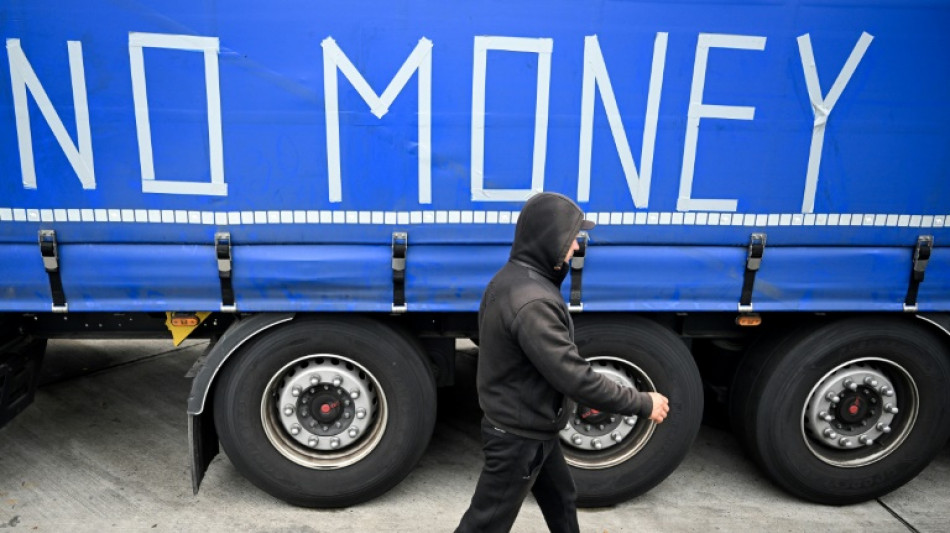
'Last hope': Desperate truckers in Germany stage hunger strike / Photo: © AFP

Truck drivers who transport goods around Europe have staged a hunger strike in Germany as part of a weeks-long work stoppage, describing it as their "last hope" to draw attention to the exploitation they say they suffer.
It was the latest stage in an action described as "unprecedented" by union officials, and which has seen some 80 drivers set up an encampment using their vehicles at a motorway service station.
Believing their Polish employers would not respond to their growing desperation amid the 10-week strike, some of them stopped eating last week.
The truckers -- mostly from Uzbekistan and Georgia, with a handful also from Tajikistan, Ukraine and Turkey -- started to take food again at the weekend after several days, but the stoppage itself continues.
The drivers claim they are not being regularly paid their salaries -- at a daily rate of about 80 euros -- and were charged hefty amounts to even take the jobs in the first place. They say they also face inhumane conditions such as having to work extremely long hours.
"I just want to be paid the money that I have earned," Roman Gujabidze, a Georgian trucker lying under a blanket in the back of his truck told AFP, at the service station in Graefenhausen, outside Frankfurt.
He was among those who joined the hunger strike, and said it was "our last hope," adding: "There was nothing more to be done."
Another driver, Fayzullo Nematov, said he was desperate to get the money he is owed so he could send it to support his wife, children and elderly mother back home in Uzbekistan.
"I'm the only one who is earning," he said.
- Across Europe -
The drivers work for several Polish trucking companies owned by the Mazur Group.
But in a statement, the group insisted that all salaries were paid "in a timely manner" and they had undergone a recent inspection which found no irregularities in payments.
The firm also sought to distance itself from the issue of fees paid to obtain visas or work recommendations, insisting the drivers had to take this up with "intermediary" companies whose services they had used to be recruited.
And they pushed back at the suggestion of forcing drivers to work long hours, saying they "cannot dictate to drivers the hours of daily work or the limit on days off," adding this was the truckers' choice.
The drivers transport a range of goods for major European companies, working in countries including Germany, France, Italy, Austria, the Netherlands and Switzerland.
While they receive regular small allowances for food, the truckers said they can go for months without receiving their salaries, and when it does come, it is usually lower than what they should be.
They are demanding 500,000 euros ($530,000) in what they say are unpaid wages.
They chose to stage their strike in Germany, rather than Poland, as they feel safer taking action there, said Edwin Atema, head of Road Transport Due Diligence Foundation, which monitors and addresses violations of labour standards in Europe.
They also staged a successful work stoppage in the same place earlier this year, albeit for a shorter period.
- 'Totally exploited' -
Such an action is "unprecedented" in the European trucking industry, Atema said.
"For the drivers, this is mentally and physically so tough. (They) came here because they are totally exploited, they did not get their money, they have problems at home, cannot feed their kids."
It highlights the convoluted supply chains that transport goods rapidly around affluent European markets which, critics say, leave those actually doing the work vulnerable.
By hiding behind other companies who transport their goods, well-known firms "try to deny responsibility for this," said Atema, also a Dutch union official.
"The root cause is always that this issue has no priority," he said. "As long as the goods are moved, nobody cares how drivers are exploited."
The drivers and companies have levelled complaints against each other, and prosecutors confirmed they are looking into allegations from both sides.
But the drivers insist they are on the receiving end of the bad treatment -- and their message is clear.
"Pay us our money, we need to send it to our families," said driver Nematov.
(N.Loginovsky--DTZ)