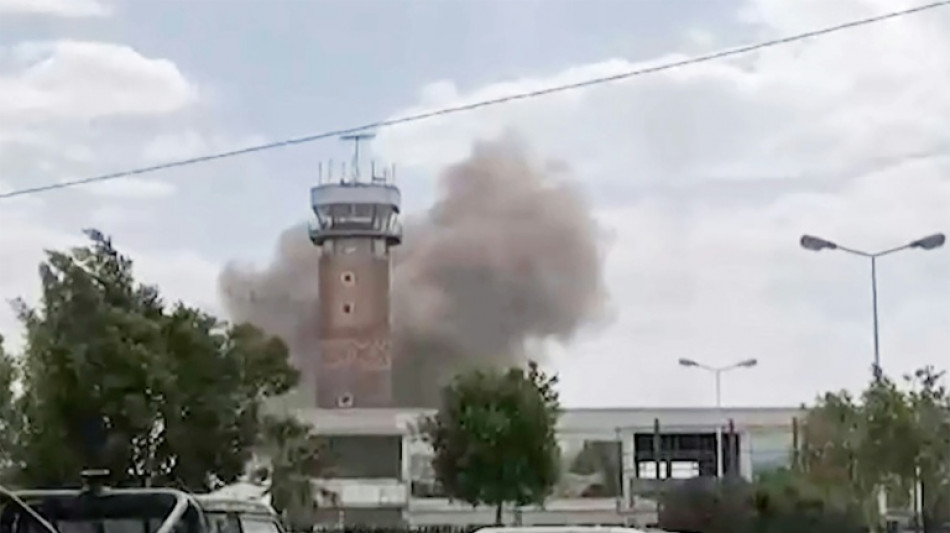
Yemen government says attacked Sanaa airport, reviving dormant conflict / Photo: © AL-MASIRAH TV/AFP

Yemen's internationally-recognised government said it struck Houthi-controlled Sanaa airport on Monday, its biggest flare-up in years with the rebels, who blamed the authorities' Saudi backers for the attack and threatened retaliation.
The government said it had wanted to prevent an Iranian plane from landing in the capital, after failing to convince a Houthi delegation that went to Tehran for the late Iranian supreme leader's funeral to board a Yemenia flight instead.
Houthi military spokesman Yahya Saree accused Saudi Arabia of "ending the de-escalation phase" and warned that "this aggression will not go unanswered or unpunished".
The latest escalation threatens to unravel a truce that has been holding since 2022 and comes at a time of heightened tensions as the United States and Iran trade tit-for-tat attacks impacting the Gulf.
The head of the Presidential Leadership Council, Rashad al-Alimi, said he had "ordered that the scope of the confrontation not be expanded in a manner that would achieve Iran's objective of dragging Yemen and its people into wars".
The United Nations Special Envoy for Yemen, Hans Grundberg, urged the parties to turn to diplomacy, saying his office has "contacted military representatives from all sides".
"We are urging them to de-escalate and refrain from any actions that would risk a new cycle of violence in Yemen."
Mohammed al-Basha of the US-based risk advisory Basha Report told AFP there is a risk of the 2022 ceasefire failing.
"If this cycle of action and retaliation continues, it could effectively mark the collapse of the April 2022 ceasefire framework and signal a return to a much more intense phase of the conflict," he said.
"The coming days will likely show whether both sides are prepared to move back toward sustained military escalation and ground war," he noted, adding that the next move of the plane, which the rebels said had landed, will likely determine how things will go.
Yemen's defence ministry accused the Houthis of "allowing an Iranian plane to violate Yemeni territory; consequently, the airport runway was targeted".
The Houthis' al-Masirah TV had previously reported that "Saudi aggression targeted the departure and landing runways at the Sanaa international airport".
For more than a decade, aircraft entering Yemeni airspace have needed prior clearance from the Saudi-led coalition that backs the government and says it enforces the restriction at its request.
The government ordered all airports in the country shut "until further notice, with immediate effect" on Monday.
Since a Saudi-led coalition entered the war in 2015 to back the government, that coalition has been the one to conduct air strikes on Houthi targets on behalf of the government.
The Houthis appeared to have challenged this arrangement by organising direct flights from Iran to Sanaa, angering the government and its backer.
- 'Ending de-escalation' -
Tensions had been rising for days, as the Houthis accused Saudi Arabia earlier this month of attacking an Iranian plane that landed in Sanaa and took off carrying the delegation.
The rebels had threatened at the time to hit Saudi airports and vital assets should Riyadh violate its airspace or attempt to attack it again.
The latest strikes raised the spectre of renewed Houthi attacks on Saudi Arabia after years of relative calm between the two foes.
The Houthis' foreign affairs ministry said the attack, blamed on Riyadh, marked "the end of the phase of de-escalation and the ceasefire and declares the start of war".
Houthi broadcaster al-Masirah quoted the group's transport minister as saying "the Iranian plane has landed on the homeland's soil, carrying a number of medical patients and stranded citizens" accompanied by the rebels' official delegation.
The Houthis have been at war with Yemen's government since 2014, in a conflict that has killed hundreds of thousands of people and triggered a major humanitarian crisis.
The rebels control Yemen's capital Sanaa and much of the north, including most population centres, while the internationally-recognised government holds much of the south.
Until the latest flare-up, fighting between the two sides had largely been frozen since a UN-negotiated truce in 2022.
(P.Vasilyevsky--DTZ)