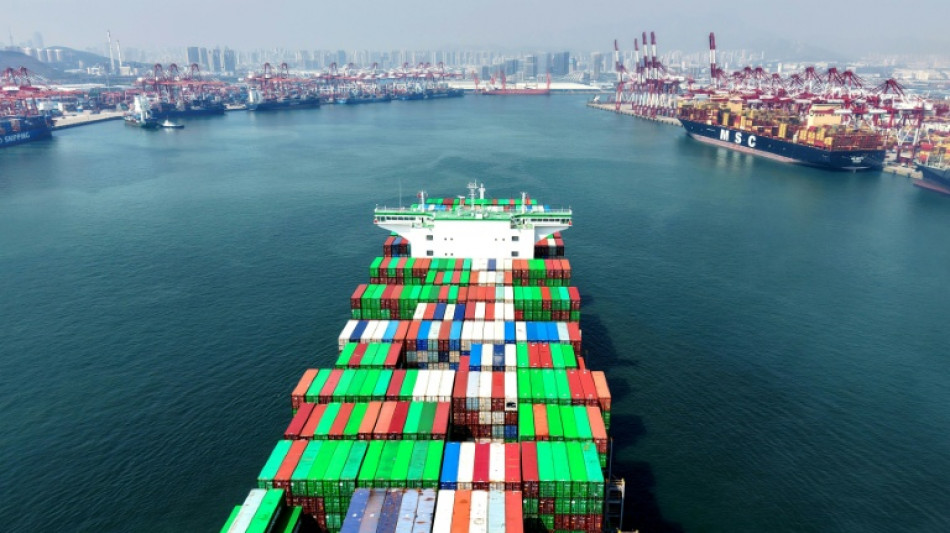
China's economic growth hits slowest pace in more than three years / Photo: © CN-STR/AFP

China's economy grew at its weakest pace in more than three years during the second quarter, data showed Wednesday, missing expectations even as strong exports driven by the global AI boom helped offset trade disruptions caused by the Middle East war.
The 4.3 percent year-on-year expansion reported by the National Bureau of Statistics (NBS) for April-June, was short of the 4.5 percent forecast in an AFP survey of economists and the slowest growth since the fourth quarter of 2022.
It was also short of the 4.5-5.0 percent annual rate targeted by Beijing, which is the lowest in decades.
A years-long crisis in the property sector and a persistent slump in domestic spending have left leaders reliant on exports to meet growth targets.
However, the US-Israeli war on Iran has threatened that as it chokes shipping through the Strait of Hormuz -- a vital transit route through which a fifth of global oil and natural gas normally passes.
"In the first half of the year, the national economy operated within a reasonable range," the NBS said in a statement.
"There are many unstable and uncertain external factors, and the domestic contradiction of strong supply and weak demand is prominent. The foundation for the economy to improve still needs to be consolidated," it added.
The NBS data also showed retail sales grew 1.0 year-on-year in June, beating a Bloomberg forecast of a 0.1 percent drop.
And industrial production rose 5.3 percent last month, topping a Bloomberg estimate of 4.6 percent.
But in a gloomy sign, fixed-asset investment slid 5.7 percent on-year in the first half.
- AI-driven export boom -
Domestic demand dampened by low income expectations remains China's "weakest link", Yue Su of The Economist Intelligence Unit told AFP.
"We therefore expect policymakers to place greater emphasis on boosting consumption in the second half of the year and into early 2027" through fiscal stimulus packages, increased minimum wages or directing wage growth towards frontline workers, she said.
But analyst Zhang Zhiwei said the government was unlikely to change its policy stance in the coming months as a result of the latest figures.
"We need to keep in mind that the first-quarter GDP growth was strong at five percent. This means the government is still on track to deliver growth in line with the official (annual) target they set at 4.5-5 percent," Zhang wrote in a note.
"The export boom just continues to beat expectations, and it will likely remain strong in the short term," he added.
The closely watched figures followed data Tuesday that showed exports surged a forecast-topping 27.0 percent year-on-year in June as the global AI boom helped fuel demand for chips and computing equipment.
China's semiconductor exports more than doubled in value in June year-on-year, while data-processing equipment shipments rose 53.1 percent from a year earlier.
But that expansion was "entirely a price story caused by the ongoing shortage of memory chips", Julian Evans-Pritchard of Capital Economics said Tuesday, noting that the volume of semiconductor exports actually fell year-on-year in June.
Tensions with the United States and European Union remain a source of friction.
China remains locked in a simmering trade feud with the EU, with which it recorded a trade surplus of $32.9 billion in June.
And while ties between Washington and Beijing have stabilised since US President Donald Trump visited Beijing in May, a trade imbalance and rivalry over chip production persist.
(L.Barsayjeva--DTZ)