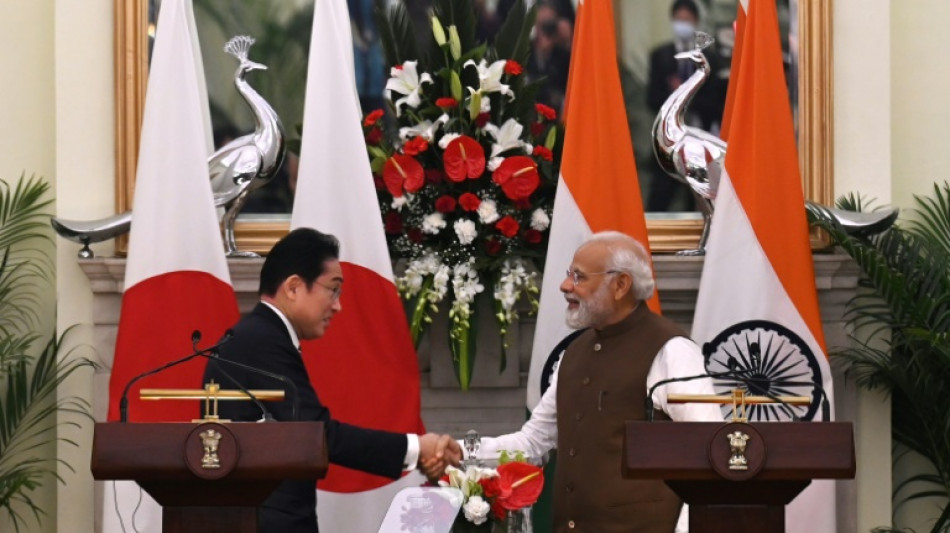
Japan PM says India 'indispensable' in ensuring free Indo-Pacific / Photo: © AFP

Japanese Prime Minister Fumio Kishida on Monday called India vital to ensuring a free and open Indo-Pacific after talks with his counterpart touching on shared concerns about China.
Speaking in New Delhi after meeting Prime Minister Narendra Modi, Kishida laid out plans for billions of dollars in investments in infrastructure and other sectors across the region.
"I have described Japan's plan to develop a free and open Indo-Pacific. To achieve this, India is an indispensable partner," Kishida said.
"Japan will strengthen coordination with the US, Australia, UK, Canada, Europe and elsewhere. Of course, India is indispensable."
India, Japan, the United States and Australia make up the Quad alliance, which positions itself as a bulwark against China's growing assertiveness in the Asia-Pacific region under President Xi Jinping.
India's relations with China nosedived after 20 Indian troops died in clashes with Chinese soldiers in 2020 on their disputed Himalayan frontier.
In December Japan, officially pacifist since 1945, revamped its defence policy after warning that China, with which it has a fraught history, posed the "greatest security challenge ever".
Japan is also boosting military spending and is carrying out more joint exercises with other countries, including India, which has also deepened defence cooperation with Western nations.
- Quad summit -
In June, Kishida had said Japan would help train 800 maritime security personnel and provide at least $2 billion to other countries to buy patrol boats and build up infrastructure as part of the Free and Open Indo-Pacific (FOIP) strategy.
Kishida said Monday that FOIP's scope would expand to include new areas like climate change, cybersecurity and food security.
It would also direct public and private capital worth $75 billion towards Indo-Pacific infrastructure by 2030.
Kishida's visit came less than a fortnight after Modi hosted his Australian counterpart Anthony Albanese for talks that also covered worries about China.
Albanese, who is also forging closer ties with the United States and Britain under the separate so-called AUKUS alliance, is due to host all Quad leaders in May.
The Quad members deny hostile intentions and stress that they are not a military alliance, but China has described the grouping as an attempt to encircle it.
Kishida had been expected to press Modi to take a tougher line on Russia's invasion of Ukraine, which India -- a major buyer of Russian arms and oil -- has refused to condemn.
There are fears that China may begin providing military assistance to Russia -- despite denials from Beijing -- and Xi was in Russia for talks with his "old friend" President Vladimir Putin on Monday.
Kishida said that there was a "lack of guiding perspective that is acceptable to all about what the international order should be.
"This was clearly demonstrated by the considerable discrepancies in the attitudes across various countries to Russia's aggression against Ukraine," he said in his speech.
- G7 invites -
He added that he had invited Modi and the leaders of other countries in the region -- including South Korea, Indonesia and Vietnam -- as well as Brazil to a G7 summit in May.
India currently holds the rotating presidency of the Group of 20, which also includes China and Russia.
G20 meetings in India this year have failed to agree joint common statements on the war because of differences over the year-old Ukraine conflict.
Modi and Kishida also discussed deeper cooperation on clean energy, digital trade and infrastructure.
In March 2022, in his first visit to India, Kishida said Japan would realise 5 trillion yen in public and private investment to India over the next five years.
(L.Møller--DTZ)