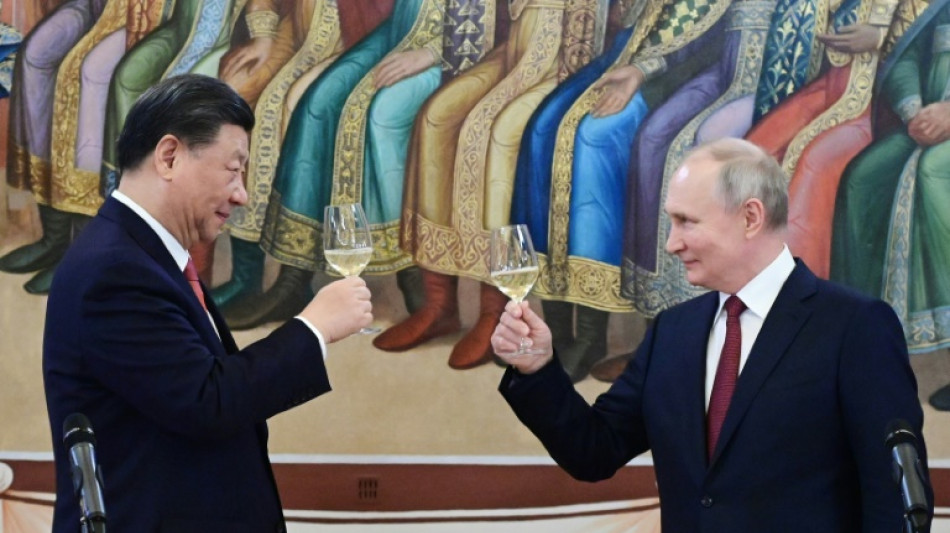
'Unlimited possibilities': Key takeaways from Putin-Xi summit / Photo: © SPUTNIK/AFP

Russian President Vladimir Putin hosted Chinese leader Xi Jinping for two days of closely-watched talks on Monday and Tuesday.
Here are five key takeaways from the Putin-Xi summit:
- 'A new era' -
The two days of talks at the Kremlin were heavy on pomp and ceremony as Putin and Xi hailed a "new era" in the two countries' relationship. The Russian leader said that bilateral cooperation "has truly unlimited possibilities and prospects" and toasted the "prosperity" of Russian and Chinese people at a state dinner after the talks.
The summit was seen as a coup for internationally isolated Putin just days after the International Criminal Court announced it had issued an arrest warrant against the Russian leader for the "unlawful deportation" of Ukrainian children.
China analyst Alexander Gabuev said that the Hague-based court's arrest warrant "only increases" China's leverage over Russia.
"Xi Jinping can't be embarrassed by meeting Putin, and the verdict only puts Xi's 'dear friend' in the Kremlin deeper into his pocket," said Gabuev, senior fellow at the Carnegie Endowment for International Peace.
- Ukraine conflict -
Xi called for dialogue over the conflict, while Putin praised China's peace initiative for Ukraine and said it could form the basis of any future settlement if both Kyiv and the West are ready for it. "However, so far we have not seen such readiness on their part," the Russian leader added.
The two leaders also signed a declaration saying it was important to "respect the legitimate concerns of all countries."
The declaration stressed it was important to prevent the Ukraine conflict from getting out of control.
"The parties call for an end to all steps that contribute to the escalation of tension and prolongation of hostilities, to avoid a further deterioration of the crisis," it read.
- Security and military cooperation -
The declaration signed by Putin and Xi said the two countries were concerned by NATO's growing presence in Asia and accused Washington of "undermining" global security.
"The parties call on the United States to stop undermining international and regional security and global strategic stability in order to secure its unilateral military advantage," the two countries said.
Speaking to reporters after the talks, Xi said that as permanent members of the UN Security Council Moscow and Beijing will promote a multipolar world and contribute to food and energy security.
Chinese-Russian relations are important for "the modern world order and the fate of mankind," added Xi.
Moscow and Beijing said they will regularly conduct joint military exercises and ramp up cooperation between their armed forces.
- Energy cooperation -
Putin -- who is seeking to redirect Russia's energy supplies to Asia due to Western sanctions -- said that Moscow could meet Beijing's "growing demand" for energy resources.
He said an agreement had been reached on the Power of Siberia 2 gas pipeline, which would send Russian natural gas to China via Mongolia.
Russian energy giant Gazprom said on Tuesday it had reached a daily record in gas volumes supplied to China through the existing Power of Siberia pipeline.
- Economic cooperation -
Russia has been pummelled by multiple rounds of unprecedented Western sanctions over Moscow's assault on Ukraine, and Putin said that expanding economic cooperation between the two countries was a "priority" for Russia.
The two leaders signed a declaration on the development of key areas of economic cooperation through to 2030. Putin particularly stressed cooperation in agriculture, and said Russia was ready to ramp up supplies of meat and grain to China.
He also said that by joining forces the two countries could become world leaders in IT and artificial intelligence.
Putin also said Russia favoured the use of the Chinese yuan in trade with Asia, Africa, and Latin America.
"President Putin and I agreed to step up comprehensive planning at the highest level, increase trade in energy and resources," said Xi.
Despite Russia's keen interest, analysts have warned that there will be limits to the relationship.
"President Xi will stop short of aligning China with Russia at the expense of the country's relationship with the West," said economic consultancy Macro-Advisory.
(V.Varonivska--DTZ)