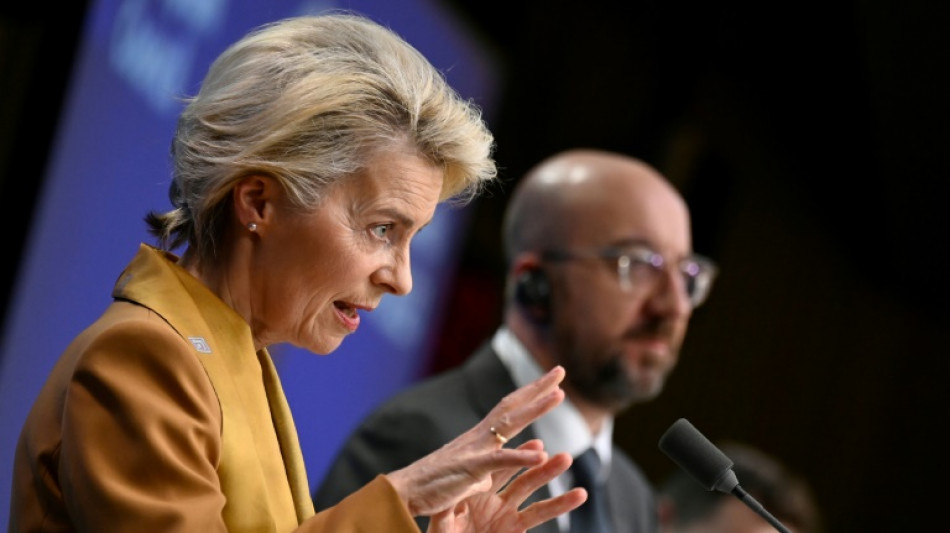
France-Germany row overshadows EU leaders' summit / Photo: © AFP

Tensions between France and Germany driven by differences over nuclear energy and combustion engines cast a shadow over a meeting of the 27 European Union leaders Thursday.
Existing strains deepened between the European Union's two biggest players after Berlin upset some of its partners by blocking -- at the last minute -- a landmark deal to prohibit new sales of fossil fuel cars from 2035.
The ban is key to Brussels' ambitious plan to become a "climate neutral" economy by 2050, with net-zero greenhouse gas emissions.
In an unprecedented move this month, Germany intervened after the car ban had already been approved under the EU legislative process.
It demanded that Brussels provide assurances the law would allow the sales of new cars with combustion engines that run on synthetic fuels.
While the last-minute block frustrated many EU capitals, Paris had in turn already irked Berlin by insisting on giving nuclear energy a starring role in European plans to produce more green technology in Europe.
Paris and Berlin have traditionally worked together to push forward the EU agenda.
The European Commission, the EU's executive arm, has been holding talks with Germany's transport ministry to resolve the dispute over cars.
After the summit ended late Thursday, commission chief Ursula von der Leyen sounded an optimistic note about the negotiations that were "progressing", but added the issue was not raised during the leaders' talks.
"There is the will on both sides to resolve this topic, and to resolve it within the scope of the provisional agreement," von der Leyen told a press conference.
German Chancellor Olaf Scholz told reporters before the summit that talks were "on the right track".
"It is now really only a matter of finding the right way to implement this promise," Scholz said.
- Pressure on Germany -
Some leaders criticised Germany's 11th-hour move to slam the brakes on a proposal that had already cleared all the hurdles in the traditional EU legislative process.
"The entire architecture of decision-making would fall apart if we all did that," Latvian Prime Minister Arturs Krisjanis Karins said.
"We cannot go back on deals because this is ultimately about trust between co-legislators and the credibility of the legislative process," said European Parliament President Roberta Metsola.
Germany, which boasts one of the world's biggest car manufacturing industries, blocked the deal signed last year in a move viewed as a product of domestic politics.
Scholz heads a coalition made up of his social democrats and rival Greens and liberals.
The synthetic fuels Germany wants an exemption for are still under development, produced using low-carbon electricity. The technology is unproven, but German manufacturers hope it will lead to the extended use of combustion engines.
While Germany led the revolt against the combustion engine ban, it is not alone. It has formed a small alliance with countries including Italy, another major car manufacturer, and eastern European states such as Poland and Hungary.
France has not held back from publicly criticising Germany.
Against this tense backdrop, French President Emmanuel Macron will meet Scholz one-on-one Friday.
- Nuclear 'scam' -
Another bone of contention hurting relations is France's push for EU recognition that nuclear power has a role to play in Europe's green future.
The commission last week launched new plans to boost clean technology production by ensuring permits are issued faster and projects given better access to funding.
Von der Leyen acknowledged that "nuclear can play a role in our decarbonisation efforts" but said only "cutting edge nuclear" would have "access to some simplified rules and incentives".
Nuclear-powered France failed to get atomic energy included in a list of technologies with access to all benefits.
Nuclear did, however, feature in the proposals announced -- but it applies only to fourth-generation reactors that do not yet exist, meaning atomic energy would obtain little of the advantages on offer.
Nuclear divides the EU, with countries like Austria and Luxembourg strongly against while its supporters include the Czech Republic and Poland.
"It's not safe, it's not fast, it's not cheap and it's not climate-friendly. With European flags on it, it would be a scam," Luxembourg's Prime Minister Xavier Bettel said.
(V.Korablyov--DTZ)