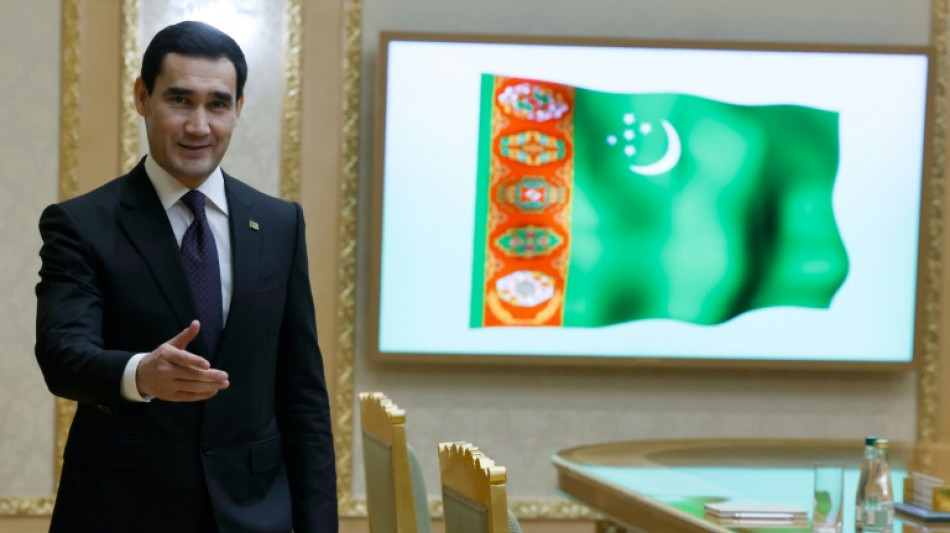
Turkmenistan stages parliamentary elections / Photo: © Sputnik/AFP/File

Parliamentary polls were underway on Sunday in Turkmenistan, a gas-rich nation ruled by one family for nearly two decades that does not tolerate political dissent or a free press.
The vote is the first under the Central Asian nation's new president, who took power following a hereditary succession in March 2022, and comes after the abolition of the legislature's upper house and the creation of a supreme body.
Polling stations opened at 7:00 am (0200 GMT) and will close at 7:00 pm (1400 GMT), according to an AFP correspondent in the capital Ashgabat.
Turkmenistan, a former Soviet republic, is one of the world's most repressive, secretive states and little is known about how the regime makes day-to-day decisions.
No election has been judged free or fair by Western poll observers.
President Serdar Berdymukhamedov reassured voters, saying: "These elections will take place according to democratic principles, in line with local legislation and international law."
But with no opposition taking part in the vote, voter enthusiasm appeared limited.
"I don't know the platform of the candidates," admitted retired 65-year-old Agamurad Biachimov before the ballot.
"Unfortunately I've not seen posters anywhere urging people to vote," he told AFP in Ashgabat.
It is difficult to find information about any policies, just the biographies of the 258 candidates listed in the "Turkmenistan Neutral", the successor newspaper to the old communist party daily in Soviet times.
Achir Ovezov, who works at Ashgabat's market, said he would not be voting.
"I have to work day and night to feed my family and I don't know the candidates," he said.
But his absence is unlikely to stop the official turnout nearing 90 percent.
- 'People expected reforms' -
Former dentist and health minister Gurbanguly Berdymukhamedov came to power in 2006, succeeding the country's founding president Saparmurat Niyazov after his death.
Berdymukhamedov, who established a strong cult of personality during his tenure, handed the reins over to his son Serdar last year after a token snap election, but kept his position as chair of the upper house of parliament.
"I watched the inauguration of the president, a lot of people were expecting major reforms from the new president," said entrepreneur Maksat Redjenov.
"We expected new factories to be built, the country to open up, the arrival of tourists, that state control would ease," he told AFP.
In January, Berdymukhamedov senior, aged 65, proposed abolishing the upper house -- created at his request in 2021 -- and set up after a unanimous vote "a supreme representative body of people's power", the Halk Maslahaty or "People's Council".
Also called Arkadag or "Protector", he was named head of the new body and observers say he remains the real power.
The new council's remit covers the main directions of Turkmenistan's domestic and foreign policy, overshadowing the unicameral national assembly and its 125 members.
Since stepping down, Berdymukhamedov has met several foreign leaders, including Russian President Vladimir Putin last year, and a new city is being built in his honour.
"The active participation of our people in the electoral process clearly shows the commitment of Turkmen society to the principles of authentic democracy," said Berdymukhamedov senior.
Turkmenistan remains one of the world's most closed-off countries, and according to Reporters Without Borders ranks 177th out of 180 countries for press freedom, ahead of Iran, Eritrea and North Korea.
Officially the nation recorded not a single case of Covid-19.
Its economy depends hugely on gas exports to China and to a lesser extent Russia and Iran.
(O.Zhukova--DTZ)