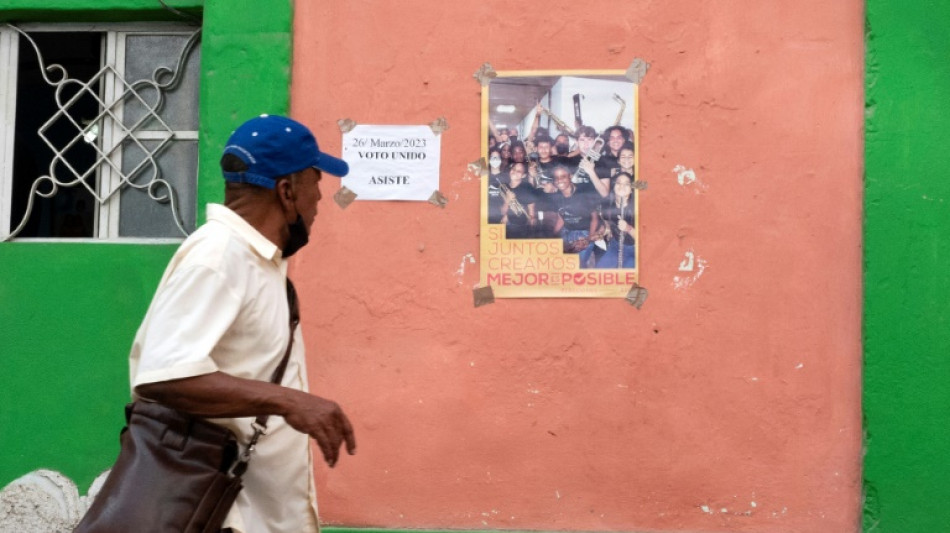
Abstention key issue as Cubans vote in parliamentary elections / Photo: © AFP

Cubans headed to the polls on Sunday for parliamentary elections in which the results are a foregone conclusion but with the abstention rate the real issue in play.
As many as eight million eligible voters will select from the 470 candidates on the ballot box vying for the 470 seats in the National Assembly.
What is really in play is the number of Cubans who refuse to vote.
The opposition has called on Cubans to abstain, with one opposition Twitter account calling the vote a "farce."
Voting is not obligatory and abstention has risen steadily in recent years.
Municipal elections in November attracted a turnout of just 68.5 percent, down from the 74 percent who voted two months earlier in a referendum on a new family code, and even further down from the 90 percent in the 2019 referendum on a new constitution.
Cuba's communist government does not allow opposition, so most of the parliamentary candidates -- made up of 263 women and 207 men -- are members of the Cuban Communist Party (PCC).
Dissident Manuel Cuesta Morua, a member of the Council for the Democratic Transition in Cuba, said that "a sociological force is becoming the largest political party in the country: the abstentionist party."
In reality, candidates still need to receive 50 percent of votes to be elected.
Voters have two choices on their ballots: they can tick the names of any number of individual candidates, or they can select the "vote for all" option.
"I voted for the unified vote because, despite the needs, the difficulties that this country can have, I could not imagine" abstaining, Carlos Diego Herrera, a 54-year-old blacksmith in Havana, told AFP.
He said abstaining would be like voting "for those that want to crush us, the Yankees."
The United States has imposed sanctions on the island nation since 1962, three years after the communist revolution that saw Fidel Castro take power after overthrowing the US-backed dictator Fulgencio Batista.
Student Rachel Vega, 19, said she had also voted for all the candidates, considering it "a step forward right now" that would "improve the situation in the country."
President Miguel Diaz-Canel is among the candidates, as is his predecessor, the 91-year-old Raul Castro.
"With the united vote we defend the unity of the country, the unity of the revolution, our future, our socialist constitution," said Diaz-Canel, 62, after voting in Santa Clara, a town 175 miles (280 kilometers) southeast of Havana.
More than 23,000 voting offices opened their doors at 7:00 am (1100 GMT) and will stay open until 6:00 pm.
(B.Izyumov--DTZ)