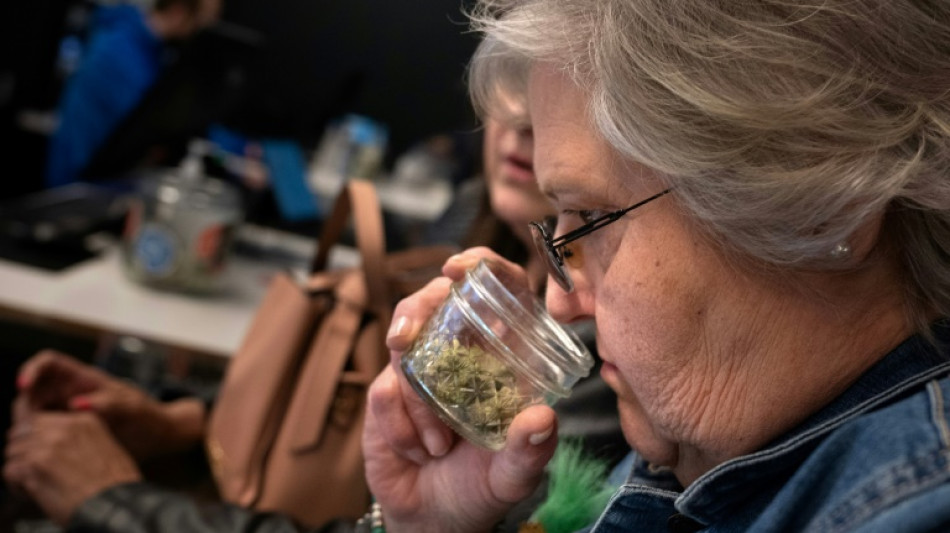
Missouri: the new haven for pot smokers in US Midwest / Photo: © AFP

Sisters Juree Burgett and Tanya Knight, both in their 60s, smell various marijuana buds, assessing their options at a trendy dispensary in Missouri. They drove three hours from Kansas -- where recreational cannabis use is still illegal -- to make their purchase.
"They will not legalize it in Kansas. They won't give us medical (usage)," says 64-year-old Burgett, clad in a denim jacket.
The shop with a drive-through window is in a rundown part of Kansas City, just off the highway and over the border into Missouri, the largely conservative Midwestern state that is the latest to legalize the recreational use of cannabis.
The new regulation, approved by voters in a referendum in November, has sparked an economic boom for the "Show Me" state, fueled by thousands of pot smokers from the eight states along its borders, most of which have not legalized the drug.
For Burgett, making the long drive is "easier than getting it off the streets."
She ends up buying chewing gum infused with THC, the active ingredient in cannabis, one of the popular edibles in a country where more than half of the 50 states have decriminalized marijuana in some form.
Burgett, who worked as a dietician, and Knight, a pastry chef by training, are now both retired.
Before Missouri's new law took effect, the pair used to drive from Kansas to Colorado -- an eight-hour trip in each direction -- to make their purchases. The mountain state was one of the first to liberalize its cannabis consumption laws.
That journey "cost us more money, almost as much as the marijuana," said Knight, who suffers from arthritis and depression.
"Now, we just go three hours. And it's really good for you. It's really good," she added, a small packet in her hand and a smile on her face.
- 'Crazy' -
Of the states on Missouri's border, only Illinois has moved to decriminalize recreational cannabis use, meaning that dispensaries like the one in Kansas City -- one of several Proper Cannabis locations -- are sitting on a potential gold mine.
At that particular outlet, more than half of the buyers are from outside Missouri.
"We're surrounded by so many states. They're just coming to us from everywhere. It's crazy," says employee Chris Brown, his straggly hair escaping from a multicolored hat.
Across Missouri, cannabis sales in February -- when recreational use was legalized -- totaled $103 million, as compared with $37.2 million the month before, according to the state's health department.
"That really blew us away," said Jack Cardetti, spokesman for the Missouri Cannabis Trade Association (MoCannTrade), which projects the local market will soar to more than $1.2 billion in a year's time.
- Big profits -
Twenty minutes from the store where Brown works, in the city of Independence, an unmarked building is nestled between frost-covered fields and giant warehouses.
Beyond the security gates is a production facility with 30,000 square feet (2,800 square meters) of cannabis plants.
Louie Sebald, wearing a hoodie and sporting a thin mustache, is the director of cultivation for Illicit Gardens, which runs the plant. In three weeks, it will be operating at full capacity -- 1,500 pounds (680 kilos) of buds a month.
The ceilings are lined with LED lamps, drip irrigation systems and sensors to monitor humidity and other variables. An eerie green glow dimly illuminates the hallways and cannabis dryers.
Sebald, 35, is hiring. The facility needs to move from 130 to nearly 170 employees, working around the clock. Statewide, the sector employs 13,000 people, mainly in rural areas where industrial and farm work is dwindling.
He explains the math: "If you're producing for $400 (a pound), and you're selling for $2,300," the profits are clear.
- 'Then we'll go on home' -
The industry in Missouri is not starting from zero. For the past two years, medical marijuana use has been legal.
The success of that initiative -- jobs created, no major pushback or incidents reported, no political backlash -- helped fuel the campaign for recreational use for Election Day 2022.
In the end, 53 percent of voters said yes to pot in a conservative-leaning state.
At the Illicit Gardens facility, one employee carefully flips buds, while in the room across the hall, products are packaged up. Joints are rolled on site as well.
"We buy just one, then we'll stop somewhere, smoke it," says Knight.
"Then we'll go on home."
(M.Travkina--DTZ)