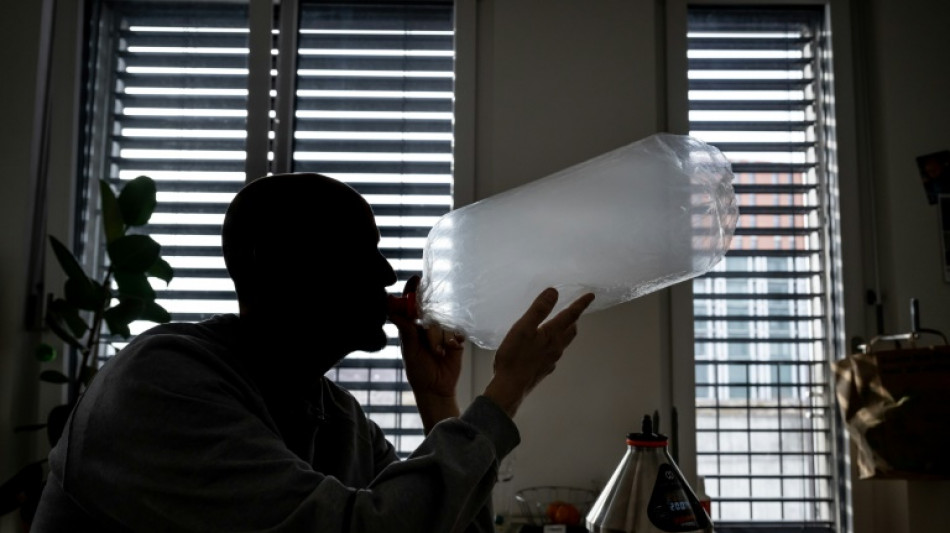
Switzerland tries slow-mo cannabis revolution / Photo: © AFP

Switzerland, which pioneered prescription heroin and safe injection sites decades ago, is now experimenting with decriminalising recreational cannabis, with the drug now available in some Basel pharmacies.
"This is 1,000 times better," said Paul, a 42-year-old resident of the northern Swiss city, as he picked up a package of cannabis from his local pharmacy.
After buying his drug of choice on the street from "weird people or criminals" for the past 25 years, Paul, who asked that his last name not be published, is taking part in a pilot programme allowing him to acquire it over the counter.
"People are happy, since they for the first time can buy it legally," pharmacist Lucas Meister told AFP, showing off a stash of colourful packages containing various dried cannabis flowers and hashish-based products.
His is one of nine pharmacies that have been chosen to take part in the two-year pilot for the legal sale of recreational cannabis.
Thousands of people applied to take part in the trial, but Paul, who mainly uses the drug to treat his depression, was among just 400 chosen.
- Not encouraging consumption -
Cannabis is legal for medical use in the wealthy Alpine nation, but only in extreme cases, such as pain relief for cancer patients.
Low-potency cannabis can also be purchased legally for non-medical use, but only when it contains below one percent tetrahydrocannabinol (THC) -- the component that gets recreational users high.
And while more potent cannabis is illegal, carrying up to 10 grammes of more potent cannabis for one's own consumption is not punishable by law.
But while there are already a few ways to consume the drug without risking run-ins with police, pressure has been mounting for legalisation.
In 2021, around 70 percent of the population favoured liberalising the laws, up from 58 percent three years earlier, according to the Swiss health ministry.
"We have to get out of the illicit cannabis framework, but ensure strict regulation," said Barbara Broers, vice president of a federal commission on issues surrounding addiction.
"It is important that people have access to controlled and regulated products, but we are proposing to ban advertising and to have plain packaging, as with cigarettes in some countries," she told AFP.
"This is not about encouraging consumption."
- Small steps -
The Swiss government has opted for a small-steps approach, and authorised trials to take place over the coming decade.
In Basel, participants are aged 18 to 76, and the aim is to study "the effects of regulated cannabis sale... on mental health and on consumption behaviour," Marc Walter, a psychiatry professor at the University of Basel and head of the study, told AFP.
So far, participants have been especially drawn to "products with a very high level of THC," he said.
The five-gramme packs that Meister keeps in his pharmacy safe contain products with THC levels ranging from 4.5 to 20 percent.
They are priced at between eight and 12 Swiss francs ($8.70-$13) per gramme, depending on the THC level, in line with black market pricing.
The pricing level was very deliberate, according to Marc Brungger, an executive at the Swiss company Pure Production, which is producing cannabis for the Basel trial.
"If prices are too low, people would try to resell the product, and if they are too high, they would turn to the black market," he told AFP.
Other major Swiss cities, including Zurich, Geneva and Lausanne, are planning to launch similar trials.
- 'Pure and organic' -
In Basel, Paul said he is thrilled to leave street dealers behind and to finally know with certainty what he is getting: "Pure and organic cannabis", grown in Switzerland and quality-guaranteed by the Swiss authorities.
"I want to consume cannabis, not chemicals made in China," he told AFP, voicing horror at the arrival on the street of synthetic cannabinoids -- laboratory-made molecules that mimic the THC effect.
The marketing specialist said it was a shame Switzerland had not taken a more direct route to legalisation, as in some US states, Canada and Uruguay.
But Walter said he was happy "Switzerland has chosen another route".
"As a scientist, I prefer that."
Frank Zobel, head of Addiction Switzerland, agreed, pointing out that taking things slow and steady to see how the population responds was a very Swiss approach.
That model proved itself in the 1990s, he said, noting how Switzerland had slowly introduced prescribing heroin for medical use.
"There too, there were four years of pilot trials, and today it is a treatment that is covered by medical insurance," he said.
(Y.Leyard--DTZ)