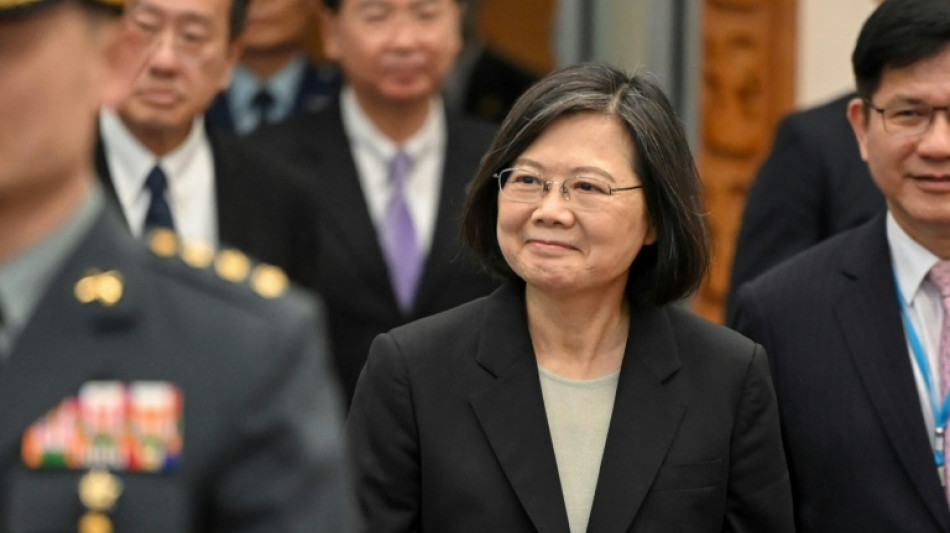
China vows to 'fight back' if Taiwan leader meets US speaker / Photo: © AFP

China vowed on Wednesday to "fight back" should Taiwan President Tsai Ing-wen meet the US House speaker during a trip to the United States.
Tsai left on Wednesday for the United States, from where she will head to Guatemala and Belize to shore up ties with diplomatic allies before heading to California, where US House Speaker Kevin McCarthy had said he would meet her.
China claims the democratic island as part of its territory to be retaken one day and, under its "One China" principle, no country may maintain official ties with both Beijing and Taipei.
Beijing warned Wednesday that it is "resolutely opposed" to any meeting between Tsai and McCarthy and vowed to take "resolute measures to fight back" if it goes ahead.
"If (Tsai) engages with US House Speaker McCarthy, it will be another provocation that seriously violates the One China principle, undermines China's sovereignty and territorial integrity, and undermines peace and stability across the Taiwan Strait," Taiwan Affairs Office spokesperson Zhu Fenglian said.
Tsai's trip follows Honduras's decision this month to open diplomatic relations with Beijing, leaving Belize and Guatemala among just 13 countries that have official ties with Taipei.
"External pressure will not hinder our determination to go global," Tsai told reporters at the airport before leaving. "We are calm and confident. We will not succumb and we will not provoke (others)."
- US call for calm -
After first visiting New York, Tsai will meet her Guatemalan counterpart Alejandro Giammattei and Belize Prime Minister John Briceno in their respective countries, her office said.
She will then stop in Los Angeles on her way home.
McCarthy has said he will meet Tsai in California, although the talks are yet to be confirmed by Taiwanese authorities.
A visit by McCarthy's predecessor to Taiwan last year sparked an angry response from Beijing, with the Chinese military conducting drills at an unprecedented scale around the island.
A senior US administration official urged China not to use Tsai's stopover as a "pretext" for aggression.
"There's absolutely no reason for China to use that as a pretext to overreact or to engage in further coercion directed at Taiwan," the official told reporters on condition of anonymity, adding that the stopover did not represent a change in US policy.
- Official vs unofficial ties -
Analysts say the US stopover comes at a key time, with Beijing having ramped up military, economic and diplomatic pressure on the island since Tsai came to power in 2016, poaching nine of its diplomatic allies.
"Beijing's attempts to poach Taiwan's diplomatic partners will lead to Taiwan developing closer ties with the United States," said James Lee, a researcher on US-Taiwan relations at Academia Sinica.
The United States remains Taiwan's most important international ally -- and its biggest arms supplier -- despite having switched its diplomatic recognition to Beijing in 1979.
Lee said the strength of Taiwan's unofficial allegiances was as important as any official ties.
"The loss of official relations with third countries will be offset by a deepening of Taiwan's unofficial relations," he said.
Recent visits by a Czech delegation and a German minister were met with rebukes from Beijing.
One of Tsai's most prominent domestic political opponents, ex-president Ma Ying-jeou, continued a visit to China on Wednesday, the first such trip by a former Taiwanese leader.
Ma spoke of the need for peace at a war memorial in Nanjing.
"Both sides should avoid war, seek peace," he told local media. "Because once a war happens, there is nothing that can make up the losses."
- Diplomatic battleground -
Tsai heads to Latin America at a time when China has upped investment in the region, a key diplomatic battleground between Taipei and Beijing since the two sides split in 1949 after a civil war.
Taiwan accused China on Sunday of using "coercion and intimidation" to lure away its allies after Honduran Foreign Minister Enrique Reina and his Chinese counterpart Qin Gang officially launched relations in Beijing.
Honduras, one of the poorest countries in the region, made the switch due to economic necessity, Reina had said earlier.
The move continued a trend in Latin America, with Nicaragua, El Salvador, Panama, the Dominican Republic and Costa Rica all switching diplomatic recognition to Beijing in recent years.
In addition to Guatemala and Belize, Taiwan still has official ties with a handful of countries in Latin America and the Caribbean, including Paraguay and Haiti.
burs-aw-oho/aha/pbt
(P.Tomczyk--DTZ)