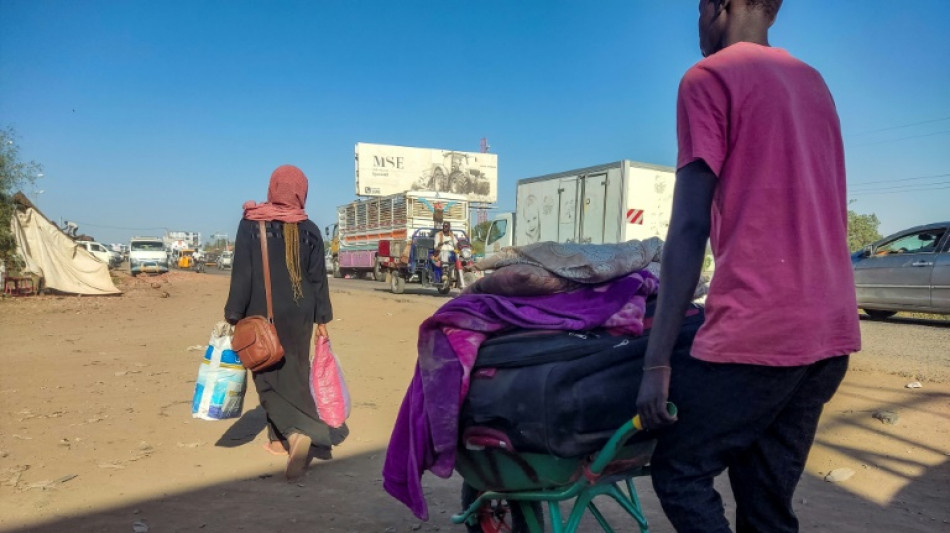
Sudanese in 'total panic' as paramilitaries move south / Photo: © AFP

On a countryside road in battle-ravaged Sudan, the hum of a passing vehicle turns villagers' blood cold, fearing the arrival of paramilitaries plundering their way south in their war against the army.
"They've created a state of total panic," said Rabab, who lives in a village north of Wad Madani, the Al-Jazira state capital and latest site of fierce battles between the army and the paramilitary Rapid Support Forces (RSF).
Like others AFP spoke to, she requested to be identified by first name only out of fear of retaliation from fighters who have consistently targeted civilians during more than eight months of war.
On Saturday at least eight people were killed by RSF fighters in a village in Al-Jazira state, witnesses told AFP, saying they had been shot after trying to stop their looting.
Just south of Khartoum, more than half a million people had sought shelter in Al-Jazira after the fighting overwhelmed the Sudanese capital.
This month, however, paramilitaries pressed deeper into the state and shattered one of the country's few remaining sanctuaries, forcing more than 300,000 people to flee once again, the United Nations said.
Those who remain -- unable or unwilling to leave -- have found themselves in what the Red Cross has called "another death trap".
Since April 15, Sudan has been gripped by a war pitting army chief Abdel Fattah al-Burhan against his former deputy, RSF commander Mohamed Hamdan Daglo.
By the end of November, at least 12,190 people had been killed in the fighting, according to a conservative estimate from the Armed Conflict and Location Event Data project.
The United Nations says more than seven million people have been displaced by the war. At least 85,000 had sought refuge in Wad Madani.
In the village of Aykura, 30 kilometres (19 miles) north of Wad Madani, one resident told AFP by phone that "the RSF has taken everything -- the cars, the trucks, the tractors".
He, too, stressed the need for anonymity to protect him from paramilitary violence.
- 'At war with us?' -
Before the war, Al-Jazira was a key agricultural hub.
However, as the RSF has moved southwards from Khartoum it has taken over swathes of agricultural land and terrorised the farmers that till it.
By Saturday, RSF fighters were seen north of Sennar, about 140 kilometres south of Wad Madani, according to witnesses.
The RSF has become notorious for looting property, with civilians who fled watching in horror as fighters posted videos of themselves on social media taking joyrides in stolen cars and vandalising homes.
In the market of Hasaheisa, a town 50 kilometres north of Wad Madani, an AFP correspondent saw shop doors flung open with the merchandise looters had not wanted strewn on the ground.
Omar Hussein, 42, stood in the wreckage of his family business.
Every store and vehicle they owned was destroyed. "Is the RSF at war with the army or with us?" he said.
On Saturday, fellow Hasaheisa resident Abdin found "seven men in RSF uniform carrying machine guns" at his door.
They questioned him about the car in his driveway, "and took it at gunpoint".
When Rabab was robbed, she did not receive the courtesy of a knock.
"They fired their guns in front of the house, stormed in and left no room unsearched," she said.
- Free rein -
Home invasions have been a hallmark of RSF takeovers -- as have sexual assaults.
According to Sudan's Combating Violence Against Women Unit, most sexual violence occurs "inside homes, when gunmen -- whom survivors describe as wearing RSF uniforms -- break in and assault women and girls".
Both the RSF and the army have been accused of a range of systematic violations including indiscriminate shelling of residential neighbourhoods, arbitrary detention of civilians and torture.
In Tambul, halfway between Khartoum and Wad Madani, witnesses said RSF members rampaged through one of the state's main markets, shooting into the air at random.
And many who tried to flee the onslaught were unable to.
Activists, who risk their lives to document the horrors, said the RSF had set up checkpoints across the state, stopping civilians as they tried to flee and ordering them to turn back.
Three days into the RSF's assault on Wad Madani, the army said it opened an investigation into "the retreat of forces from their positions" in the city.
Burhan warned every "negligent and complacent person" would be held to account after the RSF -- accused of committing atrocities in the Darfur war where it fought on behalf of the army -- had free rein.
(M.Dylatov--DTZ)