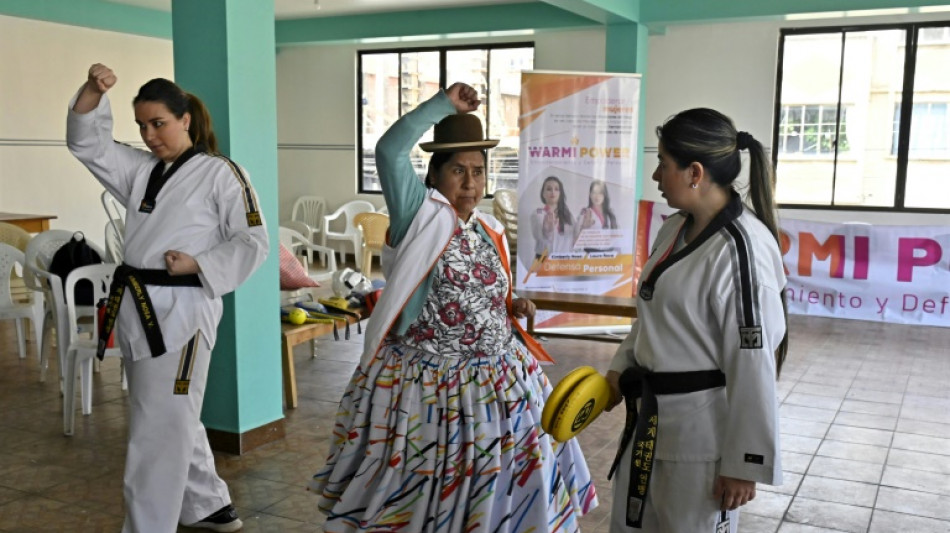
Indigenous Bolivian women take up taekwondo against gender-based violence / Photo: © AFP

A violent attack by would-be robbers steered Bolivian Lidia Mayta towards the martial art of taekwondo. Three years later, she helps train other Indigenous women to defend themselves against rampant gender-based violence in the South American country.
Mayta told AFP she would have died if neighbors had not come out of their own homes to scare off the assailants choking her outside her front door. They were trying to steal her wallet.
After the attack, she vowed she would never feel so helpless again.
She joined a woman-only class at the Warmi Power taekwondo studio in Bolivia's second city El Alto. Warmi is "woman" in the Indigenous Quechua language.
Her enthusiasm was such that the founders soon asked her to join the training team, helping in particular to translate instructions into Aymara, another of Bolivia's indigenous tongues.
"I didn't know how to defend myself, now I try to help other women lose that fear," the 56-year-old shopkeeper and community health secretary told AFP.
"This is a job of violence prevention."
Government data shows that eight out of ten women and girls in Bolivia suffer physical violence at least once in their lives.
"This is a violent country for women," said Lucia Vargas of Coordinadora de la Mujer, a rights advocacy group.
In 2023, more than 51,000 women reported falling victim to violence in the country. Husbands or partners were the perpetrators in the vast majority of cases.
- Saving lives -
Warmi Power was launched by Bolivians Laura Roca and Kimberly Nosa in 2015. Both are taekwondo black belts.
"Violence is not solved with violence, but learning to defend ourselves can save our lives," said Nosa, who has been practicing taekwondo for 18 years.
Roca is a trained psychologist who said she took up the discipline despite her father insisting it was the preserve of men.
Together, the pair have trained more than 35,000 women countrywide.
At the class in El Alto, most of the women are Indigenous and engaged in informal trade.
Many dressed in the traditional Aymara bulging skirt with woolen blanket and tall bowler hat over two long braids, they start each session with a muscle warmup.
Most have never dealt a blow in their lives and seem uncertain with the first air punches.
But they soon get into the routine. They kick, they scream, and they learn to identify an assailant's weak spots.
Mayta walks through the class correcting postures and motivating participants to project their fears onto inanimate objects, which they attack with gusto.
Among the pupils is cheese vendor Marcelina Quispe, 45.
She told AFP she was inspired to take up taekwondo by a friend's experience with domestic violence.
"Her husband told her: 'I'm going to bury you in the yard if you leave me'. I told her not to be afraid, that we would not abandon her. And I came to these classes because you never know when misfortune will come knocking," she said.
Her friend ended up running away from home.
- 'You're powerful' -
Women's rights groups in Bolivia say gender-based violence is normalized in a society where many men see women as property.
"There is a cruelty to the lives of women who seek their independence," said Vargas.
Since 2013, Bolivia has had a specific law to protect women from gender-based violence. It prescribed a 30-year prison term for the crime of "femicide" -- when a woman is killed for being a woman.
But since the law entered into force, 1,085 femicides have been reported, and critics say not enough resources are dedicated to fighting gender-based crime in Bolivia.
At the end of their class in El Alto, the taekwondo pupils walk one by one through a tunnel formed by two rows of women holding hands.
"You're beautiful, you're powerful, you're valuable, you're a warrior, you're strong," they are told, and slapped on the back encouragingly.
The class ends with a group hug.
(U.Stolizkaya--DTZ)