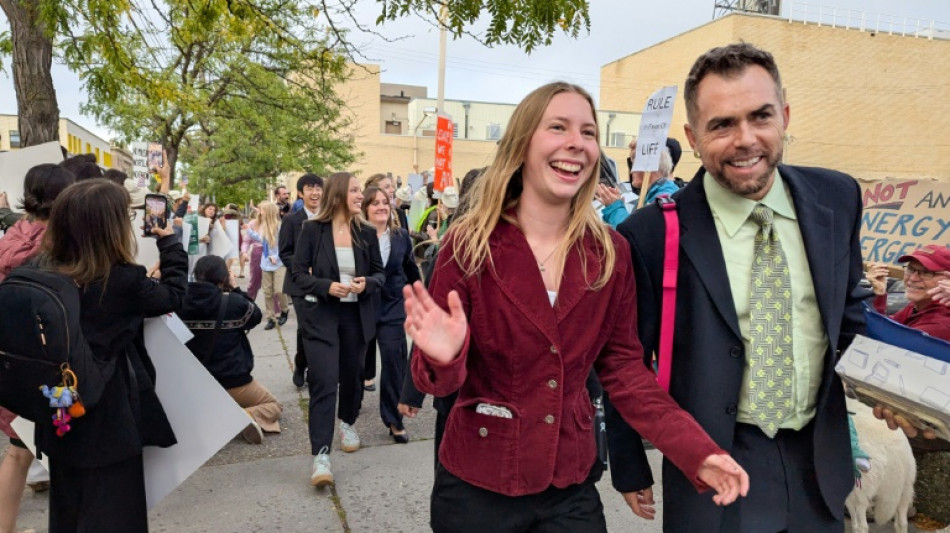
'A better future is possible': Youths sue Trump over climate change / Photo: © AFP

Smoke-choked air that fills their lungs, floods that threaten their homes and heat strokes that strike without warning: a group of young Americans testified Tuesday that President Donald Trump's fossil-fuel push is trampling their inalienable rights.
Lighthiser v Trump is emblematic of a growing global trend of legal action as a tool to push action on planetary warming amid political inertia or outright hostility.
At issue are three executive orders that "unleash" fossil fuel development and curb the electric vehicle market, invoke emergency powers to accelerate drilling, and designate coal a "mineral," granting it priority status for extraction.
They are also contesting the government's actions undermining federal climate science.
A two-day hearing opened in a federal courtroom in Missoula, Montana where Julia Olson, lead attorney for the 22 plaintiffs, framed the dispute as a constitutional test.
"Does the United States Constitution guard against executive abuses of power by executive order that deprive children and youth of their fundamental rights to life and to their liberties?" she asked.
Michael Sawyer, representing the Trump administration, countered that the case itself undermined democracy.
"This is, at its core, an anti-democratic lawsuit," he argued. "We just had an election. One of the major issues in that election was a dueling perspective on emissions, energy policy, and they are now stepping in and asking the court to overrule the results."
- Witnesses grilled -
The spotlight then shifted to the young plaintiffs, represented by the nonprofit Our Children's Trust, who described how climate change is reshaping their lives.
J.M., an adolescent minor from Livingstone, Montana, said that even in her short life she has seen snowfall decline, wildfire seasons lengthen, and flooding worsed.
One blaze forced her family to evacuate, and she remembers packing her stuffed toys and worrying about the family's horses and dogs.
"Just experiencing that from a young age put the fear of wildfire in me," she said.
Asked how she would feel if climate change worsened, she replied that "it would be heartbreaking to watch my Montana burn."
Another plaintiff, Joseph Lee, 19, recalled wildfires in California last year that destroyed the home of a friend.
"I don't know if I'm going to be next -- are my parents going to be safe?" he told the court.
Asked why he chose to participate in the lawsuit, Lee, who has been hospitalized for heat stroke, said while he wasn't hoping to undo climate change completely, it was possible to stop it getting worse: "A better future is possible."
The young people faced tough questioning from government lawyers, who grilled J.M. over her family's decision to keep three horses -- arguing that raising them contributed to greenhouse emissions -- and implying she was being hypocritical.
- Long odds -
Expert witnesses, including renowned climate scientist Steven Running and former senior White House official John Podesta, are set to take the stand Tuesday. The government has not called any witnesses.
The plaintiffs are seeking a preliminary injunction that could open the door to a full trial.
The federal government, joined by 19 conservative-leaning states and the territory of Guam, wants the case thrown out.
Most observers give the youths long odds.
Judge Dana Christensen, an Obama appointee with a record of pro-environment rulings, is presiding -- but even if the plaintiffs notch a win, the case would then almost certainly land before the conservative-dominated Supreme Court.
"They're trying to frame it as a matter of substance or due process, but that would require novel rulings from the courts to apply that to climate change," Michael Gerrard, a professor of environmental law at Columbia University told AFP.
"This Supreme Court is more about taking away rights than granting them, unless you're a gun owner."
The legal team points to recent state-level wins: a 2023 Montana ruling that oil and gas permits violated the state's constitutional right to a clean environment, and a 2024 Hawaii settlement mandating faster decarbonization of its transport sector.
But the record has proven bleak at the federal level.
The most prominent case was filed in 2015, Juliana v. United States, and eventually got dismissed after the Supreme Court refused to hear an appeal earlier this year.
(W.Novokshonov--DTZ)