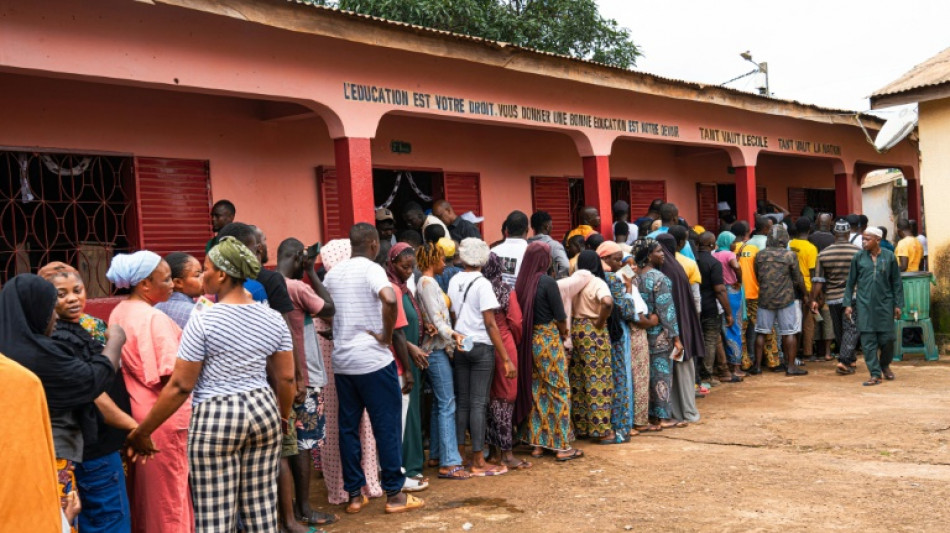
Polls close in army-run Guinea's vote on new constitution / Photo: © AFP

Guineans flocked on Sunday to vote on a draft constitution that would pave the way for elections but also allow the junta leader who seized power four years ago to run for president.
After a day's voting watched over by a hefty security presence, the west African nation's polling stations shut on Sunday evening, drawing a long-awaited referendum boycotted by the opposition to a close.
Sunday's vote opens the way for elections stalled since General Mamady Doumbouya overthrew elected civilian president Alpha Conde in 2021. In that time, Doumbouya's junta has ramped up pressure on the opposition, with many critics fleeing abroad.
"This is what everyone is waiting for," one voter, 23-year-old student Ahmad Diallo, told AFP at a school in the capital's Kaloum district.
"To have peace, and we want the transition to end."
Some 6.7 million Guineans out of a population of approximately 14.5 million people were able to cast a ballot, with provisional results expected Tuesday evening.
Campaigning has been strong in the referendum's "yes" camp: rallies, marching bands and posters depicting 40-year-old Doumbouya have been prevalent throughout the country.
The "no" campaign, however, was virtually non-existent, mainly taking place on social media and often led by the junta's critics in exile.
Despite the opposition's calls to boycott the "charade", AFP journalists saw a sizeable turnout in the affluent city centre of the capital Conakry as well as in several working-class neighbourhoods.
Sources contacted by AFP indicated turnout varied across the country, with a particularly low count in the central area of Faranah. Voting passed off peacefully.
- End to military rule? -
"We want to an end to the transition, it's not good for Guinea," Fode Fofana, 44, told AFP. "We want a transparent presidential election for a civilian president... on the international stage the military is not good for Guinea."
A 72-year-old union representative at a polling station in the poor neighbourhood of Hamdallaye, who asked not to be named, told AFP she had voted in favour of the constitution, hoping for restored constitutional order but fearing that Doumbouya would run for president.
"I came because I have always voted, it is a duty, and we must put an end to the military transition," she said.
But she argued that the referendum campaign "was not a campaign about a constitution, the propaganda was too strong".
"Did you see the armoured vehicles, the weapons, the pick-ups: is that for a constitution? No, it's to intimidate people," she added.
Authorities deployed 45,000 members of the security forces across the country Sunday to police the vote, along with 1,000 light and armoured vehicles and combat helicopters, the National Gendarmerie said.
Guinea's military initially pledged to return power to civilians before the end of 2024.
Although its authorities are now promising presidential and legislative elections before the end of the year, the junta has not yet set a date.
- 'Too much abuse' -
Since 2022, the junta has banned demonstrations and has arrested, prosecuted or pushed into exile several opposition leaders, some of whom were victims of forced disappearances.
On August 23 the junta suspended two of the country's main opposition parties for three months.
Several media outlets have also been suspended and journalists arrested.
A 28-year-old computer scientist who voted "no" told AFP the election was "outrageous", speaking anonymously near a polling station in the Cosa working-class neighbourhood.
"I regret the fact that there are fewer freedoms; there is too much abuse," he said.
Meanwhile, the Secretary-General of the Presidency, General Amara Camara, told AFP that the "constitution responds to the deep aspirations of Guineans".
If adopted, the new constitution would replace a "transition charter" established by the military government, which had prevented the junta's leaders, government members and heads of institutions from standing in elections.
That rule does not feature in the new draft constitution, paving the way for Doumbouya to stand for president.
(L.Møller--DTZ)