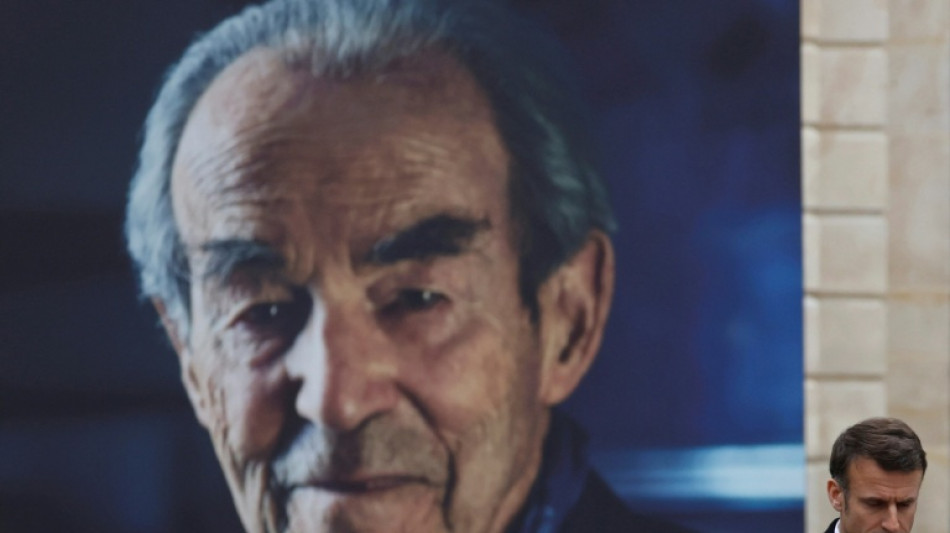
Guillotine abolitionist Robert Badinter to enter France's Pantheon / Photo: © POOL/AFP

Robert Badinter, a justice minister who ended the death penalty in France in 1981, is to enter the country's Pantheon mausoleum of outstanding historical figures on Thursday.
Badinter, a lawyer who campaigned for an end to capital punishment after one of his clients was beheaded with a guillotine in the 1970s, died last year aged 95.
His legacy also includes a 1982 law to decriminalise homosexuality.
His remains are to stay in a cemetery outside Paris, but a casket reported to contain his lawyer's robe and three books is to make its entrance into the former church on the French capital's left bank on Thursday evening.
He is to join other national heroes including French author Victor Hugo, French-American dancer and Resistance member Josephine Baker and Simone Veil, the women's rights heavyweight and health minister who championed legalising abortion.
The soft-spoken attorney was widely vilified for pushing through legislation banning the death penalty at a time when most French people still supported the practice.
He was however in his later years hailed for his integrity and statesmanship.
But on Thursday morning, just hours before the ceremony, it appeared some did not agree with his ideas.
Badinter's tombstone was vandalised with blue graffiti, local authorities said.
"Eternal is their gratitude, the murderers, the paedophiles, the rapists," the message reportedly read.
President Emmanuel Macron, who was to preside over the evening's proceedings, immediately reacted on X.
"Shame on those who wanted to sully his memory," he wrote.
- Last beheading in 1977 -
Until its abolition, capital punishment in France was carried out by beheading with the guillotine, a practice dating back to the French Revolution of 1789.
Badinter's advocacy against capital punishment started in 1972, following the beheading of his client Roger Bontems, for his secondary role in murdering a nurse and guard during a prison escape.
Five years later, haunted by his failure to prevent Bontems' death, he convinced a jury not to execute Patrick Henry for the murder of a seven-year-old boy, becoming an instantly hated figure among the French public.
He used the case as an opportunity to weigh the death penalty, calling in experts to describe the workings of the guillotine in grisly detail.
"Guillotining is nothing less than taking a living man and cutting him in two," Badinter argued.
In all, he saved six men from execution during his career, eliciting death threats in the process.
Badinter made ending the death penalty an immediate priority after becoming justice minister in June 1981, ushering a bill through parliament just months later.
The last person to be executed in France was in 1977 with the death of Hamida Djandoubi, a Tunisian immigrant convicted of torturing and murdering a young woman.
A museum in the southern city of Marseille earlier this month assembled an 800-kilogram (1,700-pound) guillotine to shine light on Badinter's legacy among its visitors.
After ending capital punishment, Badinter in December 1981 spoke in parliament in favour of decriminalising homosexuality, with a law passed the following year.
burs-ah/ekf/cc
(Y.Leyard--DTZ)