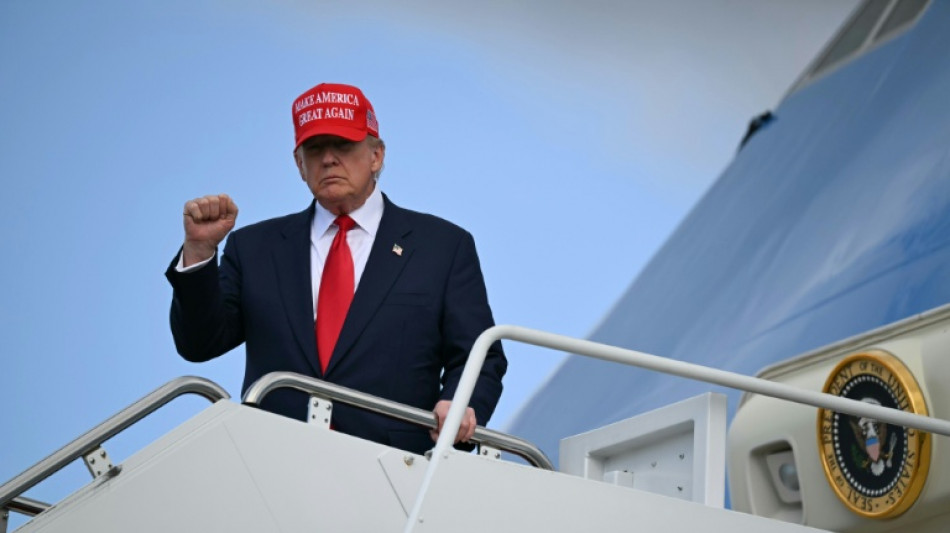
Trump stirs global tensions with surprise nuclear test order / Photo: © AFP

US President Donald Trump's surprise directive to begin nuclear weapons testing provoked global criticism on Friday, as it raised the specter of renewed superpower tensions.
The announcement on social media was issued just before Trump -- who boasts frequently about being a peace president -- went into a summit with Chinese leader Xi Jinping in South Korea.
Trump's announcement left much unanswered -- chiefly whether he meant testing weapons systems or actually conducting test explosions, something the United States has not done since 1992.
Key US foe Iran on Friday called the directive "regressive and irresponsible", adding that it was a threat to international security.
"A nuclear-armed bully is resuming testing of atomic weapons. The same bully has been demonizing Iran's peaceful nuclear program," foreign minister Abbas Araghchi posted on social media.
Japanese atomic bomb survivors group Nihon Hidankyo sent a letter of protest to the US embassy in Japan on Friday.
The directive "directly contradicts the efforts by nations around the world striving for a peaceful world without nuclear weapons and is utterly unacceptable," the Nobel Peace Prize-winning group said in the letter obtained by AFP.
- Global nuclear testing ban -
Following Trump's meeting with Chinese leader Xi Jinping, China's foreign ministry spokesman Guo Jiakun urged the United States to "earnestly abide" by a global nuclear testing ban.
China and the United States observe a de facto moratorium on testing nuclear warheads, though Russia and the United States regularly run military drills involving nuclear-capable systems.
United Nations chief Antonio Guterres said through his deputy spokesman that "nuclear testing can never be permitted under any circumstances."
The United States has been a signatory since 1996 to the Comprehensive Nuclear-Test-Ban Treaty, which bans all atomic test explosions, whether for military or civilian purposes.
Vice President JD Vance said the US nuclear arsenal needed to be tested to ensure it actually "functions properly," but did not elaborate on what type of tests Trump had ordered.
The president's statement "speaks for itself," Vance told reporters at the White House.
"It's an important part of American national security to make sure that this nuclear arsenal we have actually functions properly, and that's part of a testing regime," he added.
It came days after Russia declared it had tested nuclear-capable, nuclear-powered cruise missiles and sea drones.
"Because of other countries testing programs, I have instructed the Department of War to start testing our Nuclear Weapons on an equal basis," Trump said on Truth Social earlier this week.
Trump also claimed that the United States has more nuclear weapons than any other country.
The Stockholm International Peace Research Institute (SIPRI) said in its latest annual report that Russia possesses 5,489 nuclear warheads, compared to 5,177 for the United States and 600 for China.
The Kremlin questioned whether Trump was well-informed about Russia's military activities.
The recent weapons drills "cannot in any way be interpreted as a nuclear test," spokesman Dmitry Peskov told journalists.
"We hope that the information was conveyed correctly to President Trump."
Peskov then implied that Russia would conduct its own live warhead tests if Trump did it first.
Further muddying the waters, Trump also repeated to reporters a previous claim that he wants negotiations with Russia and China on reducing nuclear weapons forces.
"Denuclearization would be a tremendous thing," he said.
- Last US test in 1992 -
The United States conducted 1,054 nuclear tests between July 16, 1945, when the first was conducted in New Mexico, and 1992.
Its two nuclear attacks on Japan during World War II make it the only country to have used the weapons in combat.
The last US nuclear test explosion was in September 1992, a 20-kiloton underground detonation at the Nevada Nuclear Security Site.
Then-president George H.W. Bush imposed a moratorium on further tests in October 1992 that has been continued by successive administrations.
Nuclear testing was replaced by non-nuclear and subcritical experiments using advanced computer simulations.
burs-sms-dk/mlm/sla/ane/cwl
(L.Barsayjeva--DTZ)