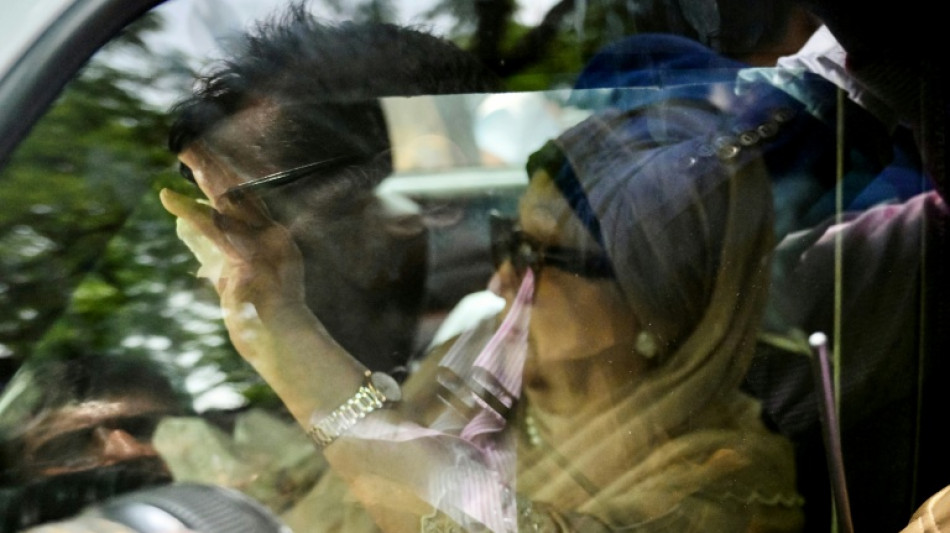
Bangladesh ex-PM Zia to contest elections: party / Photo: © AFP/File

Former Bangladeshi prime minister Khaleda Zia will contest elections expected in February, her influential political party said Monday.
The 80-year-old has been a dominant figure for decades in the country's turbulent power struggles, and her Bangladesh Nationalist Party is seen as the frontrunner in the elections.
Her participation was announced by Mirza Fakhrul Islam Alamgir, a senior BNP leader, who said she will contest in three constituencies.
The uncompromising leader has been in poor health following years of imprisonment under her arch-enemy Sheikh Hasina, who was overthrown in a mass uprising in August 2024.
Zia, who led Bangladesh three times, was jailed for corruption in 2018 under Hasina's government, which also blocked her from travelling abroad for medical treatment. She was released last year, shortly after Hasina was forced from power.
Her son, Tarique Rahman, 59, who has been in Britain since 2008, will also run, Alamgir told reporters.
Rahman, known in Bangladesh as Tarique Zia, has lived in London since 2008, saying he fled politically-motivated persecution. He is yet to return to Bangladesh.
Since Hasina's fall, Rahman has been acquitted of the most serious charge against him; a life sentence handed down in absentia for a 2004 grenade attack on a Hasina rally, which he always denied.
For decades, Bangladesh's politics has been defined by the bitter rivalry between Zia and Hasina -- a feud dubbed the "Battle of the Begums", an honorific title in South Asia for a powerful woman.
The hatred traces back to the 1975 assassination of Hasina's father, independence leader Sheikh Mujibur Rahman, along with most of her family, in a coup.
Three months later, Zia's husband, Ziaur Rahman, then deputy army chief, effectively took control. He became president in 1977. He was himself assassinated in 1981.
Zia, then a 35-year-old mother of two, inherited the BNP leadership.
Initially dismissed as a political novice, Zia proved a formidable opponent, rallying against military dictator Hussain Muhammad Ershad, and later joining forces with Hasina to oust him in 1990.
The two women alternated in power for the next decade and a half.
(Y.Leyard--DTZ)