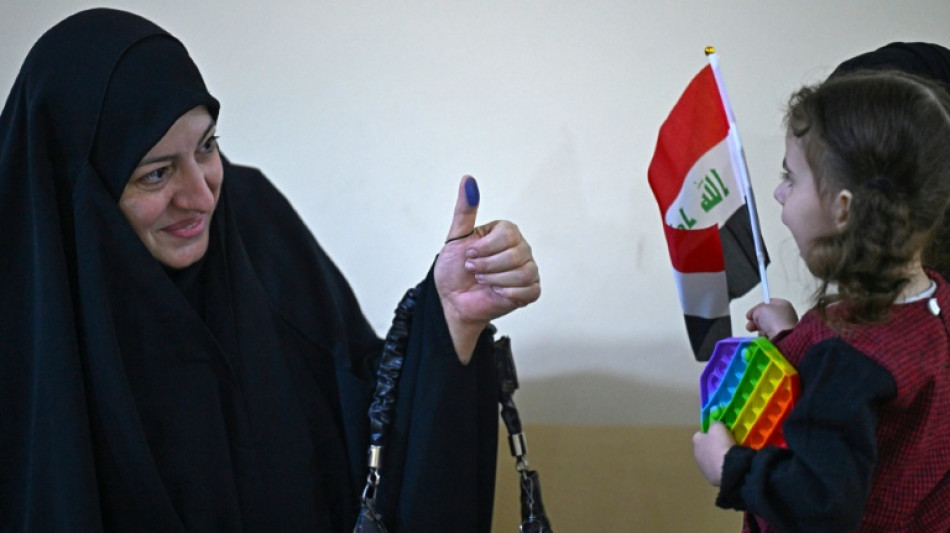
Iraqi voters turn out in numbers as region watches on / Photo: © AFP

Iraqis voted for a new parliament Tuesday, with an unexpectedly high turnout of more than 55 percent, at a pivotal time for the country and the wider region.
Iraq, which has long been vulnerable to proxy wars and is closely watched by Iran and the United States, has recently regained a sense of stability.
But, even as it tries to move past two decades of war since a US-led invasion toppled Saddam Hussein, the country of 46 million suffers from poor infrastructure and public services, mismanagement and corruption.
Iraq's electoral commission said more than 12 million people took part out of 21 million eligible voters, despite influential Shiite cleric Moqtada Sadr calling on his supporters to boycott the vote.
The unexpected turnout is a sharp jump from the record low of 41 percent in 2021, belying a sense of apathy and scepticism.
Preliminary results are expected within 24 hours of polls closing, but Prime Minister Mohammed Shia al-Sudani, who hopes for a second term, is expected to secure a large bloc but fall short of a majority.
Many voters told reporters that the elections wouldn't bring meaningful change to their daily lives and said that the vote was a sham that only benefits political elites and regional powers.
No new leadership contenders have recently emerged, with the same Shiite, Sunni and Kurdish politicians remaining at the forefront.
- Failed boycott? -
Political analyst Hamzeh Hadad said the higher turnout, even if still lower than before 2021 "is a positive step for Iraq" and shows that Sadr's "influence is really limited to his followers".
"It means no political leader can hold back democratic elections in Iraq," he added.
The ballot this year was marked by the absence of Sadr who retains a devoted following of millions among Iraq's majority Shiite population.
In 2021, Sadr secured the largest bloc before withdrawing from parliament following a dispute with Shiite parties which culminated in deadly fighting in Baghdad.
IN the years since US-led forces ousted Saddam Hussein, a Sunni, Iraq's long-oppressed Shiite majority has dominated, with most parties retaining ties to neighbouring Iran.
By convention in post-invasion Iraq, a Shiite Arab holds the powerful post of prime minister and a Sunni Arab that of parliament speaker, while the largely ceremonial presidency goes to a Kurd.
Sudani is likely to win but, with no single party or list expected to achieve an outright majority, must win over a coalition that can secure enough allies to become the largest bloc.
Sudani rose to power in 2022 with the backing of the Coordination Framework, a ruling alliance of Shiite parties and factions all linked to Iran.
Although they run separately, Shiite parties within the Coordination Framework are expected to reunite after elections and likely pick the next premier.
Sudani has touted his success in keeping Iraq relatively unscathed by the turmoil engulfing the Middle East.
Sunni parties contested separately, with the former speaker Mohammed al-Halbussi expected to do well.
In the autonomous Kurdistan region, the rivalry between the Kurdistan Democratic Party and the Patriotic Union of Kurdistan remains.
- Delicate balance -
On the ground however, Iraqis said they cast their votes hoping for a change.
"We have unemployment and people are tired, we need progress," said Ali Abed, 57, in the northern city of Mosul.
But the next prime minister has also another difficult task.
He will have to maintain the delicate balance between Iraq's allies, Iran and the US, even more so now that the Middle East is undergoing seismic changes, with new alliances forming and old powers weakening.
Even as its influence wanes elsewhere, Iran hopes to preserve its power in Iraq -- the only close ally that stayed out of Israel's crosshairs after the heavy losses Iran's other allies have incurred in Lebanon, Yemen and Gaza since 2023.
Tehran has meanwhile focused on other interests in Iraq -- challenging the US with powerful Tehran-backed armed groups, and keeping the Iraqi market open to products from its crippled economy.
Washington, which still wields influence in Iraq and has forces deployed there, conversely hopes to break Iran's grip, and has been pressuring Baghdad to disarm the pro-Iran groups.
(M.Dylatov--DTZ)