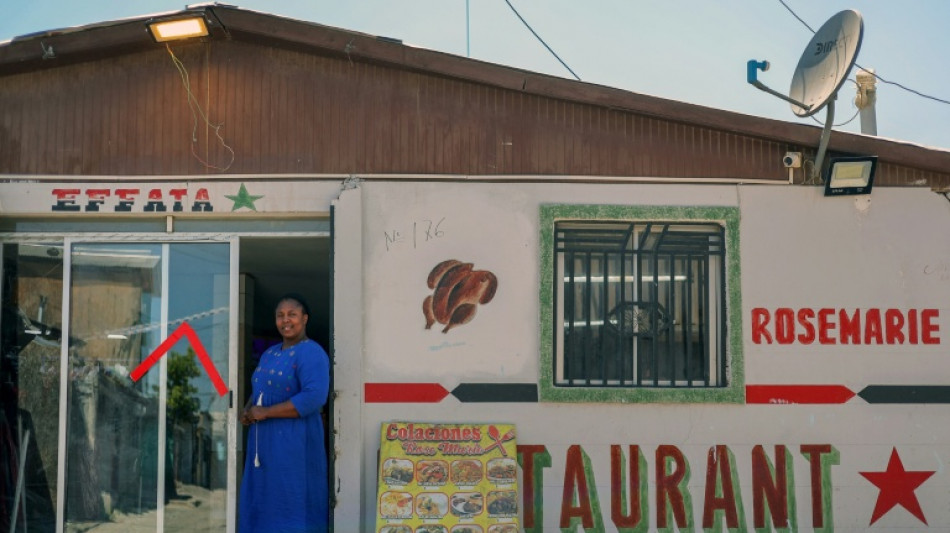
'My whole life is here': migrants in Chile fear far-right rule / Photo: © AFP

At an informal settlement near a disused landfill, a group of migrants anxiously await the outcome of Chile's presidential election, in which many voters are baying for them to be thrown out.
Illegal migration, which many Chileans link to a crime surge, is a hot topic in the election.
Two hard-right candidates are threatening to deport all of the 330,000 people living illegally in the country.
Far-right lawyer Jose Antonio Kast has called on them to sell up and leave of their own volition or be thrown out and lose everything if he becomes president.
Some 2,000 families, mostly Haitians, Peruvians, Venezuelans and Colombians, live crammed in a sea of modest brick homes with tin roofs in Nuevo Amanecer (New Dawn), a settlement west of Santiago.
Like Suhey Garcia, her husband and three children, many were smuggled into Chile on foot after crossing the Andean high plains from Bolivia.
"If they're going to kick me out, well, there's nothing I can do. But making that decision myself? No," said 30-year-old Garcia.
She and her family fled the economic meltdown of their native Venezuela in 2020.
Nearly 700,000 Venezuelans have crossed the continent to Chile, one of Latin America's most prosperous and stable countries, becoming the country's biggest immigrant group.
In the world's biggest copper producer, they can find work as delivery drivers, security guards, farm laborers or, like Garcia's husband, in construction, despite not having papers.
"I've built my life here," Garcia, a stay-at-home mother said.
Residents of Nuevo Amanecer live a frugal existence, with running water but no sewage system.
The houses are illegally connected to the electrical grid. Children play in dusty alleyways.
"Imagine they send me back to Venezuela. I don't have a home there. My children already have a stable life in Chile," she said.
The plans for mass migrant roundups and deportations of Kast and his ultra-right rival Johannes Kaiser smack of US President Donald Trump's campaign for what is now his second stint in the White House.
Kast, whom polls place second behind left-wing candidate Jeannette Jara in the first round of the election on Sunday, has also vowed to dig trenches, build fences and deploy troops at weak points along Chile's 861-kilometer (530-mile) border with Bolivia.
- 'A stable life' -
Chile's migrant population has doubled in seven years to 8.8 percent of the population, one of the highest rates in the region.
Until now undocumented foreigners have lived relatively freely in Chile.
A recent law aimed at slowing the tide of arrivals prevents them from regularizing their status, but their presence has been tolerated.
They also have access to health care and the public school system -- services which Kast has vowed to cut, if elected.
Both he and Kaiser have suggested rounding up undocumented immigrants, including children, and keeping them in detention centers pending their deportation.
"I think it's unfair because we are all human beings. Personally I didn't come here to commit crimes. Why do they lump us all together?" Garcia asked.
Colombian native Nancy Guevara entered Chile as a tourist in 2024 and then remained illegally.
Her partner, an undocumented Haitian migrant, appeals to Kast to "give people a chance."
"Give them papers so they don't have to live here illegally."
Even migrants with legal status fear their lives would be turned upside down if the far-right wins power.
Wilmer Carvajal, a 40-year-old Peruvian living in Chile for 13 years, said he fears Nuevo Amanecer will be razed and that families would find themselves on the street, "children and all."
(L.Barsayjeva--DTZ)