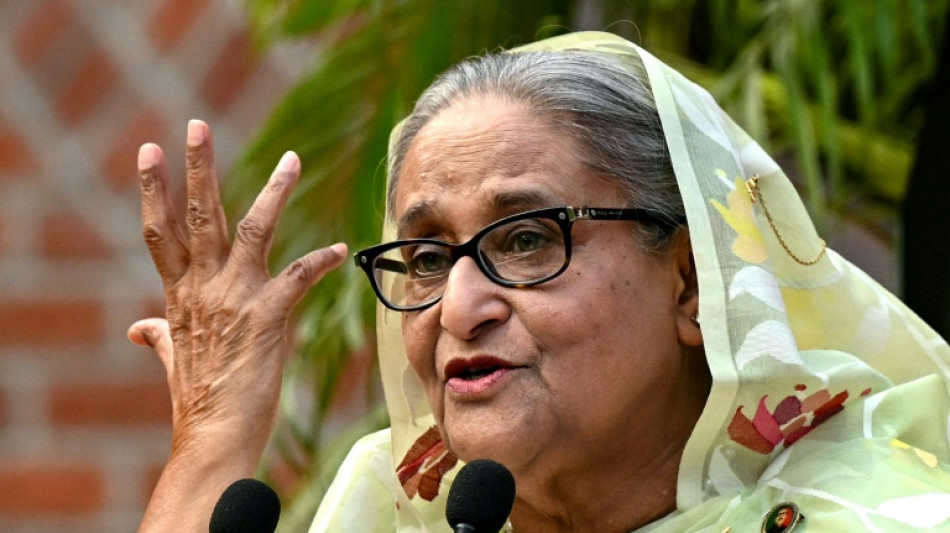
Bangladesh's Hasina: from PM to crimes against humanity convict / Photo: © AFP/File

Bangladesh's Sheikh Hasina, whose autocratic rule was ended by a mass uprising she tried to crush, had her downfall sealed on Monday when she was sentenced to be hanged for crimes against humanity.
Once praised for overseeing Bangladesh's rapid economic rise, she fled to neighbouring India by helicopter in August 2024 as angry crowds stormed her palace and has remained in hiding ever since.
Critics accused her of jailing political rivals, enacting harsh anti-press laws, and overseeing widespread human rights abuses, including the killing of opposition activists.
The 78-year-old fugitive defied court orders to return to attend her trial on whether she bore command responsibility for the bloody crackdown on the student-led uprising.
Up to 1,400 people were killed between July and August 2024, according to the United Nations.
- Corruption charges -
The court in Dhaka sentenced her to death after finding her guilty on Monday on three counts of crimes against humanity that included incitement and ordering to kill and inaction to prevent atrocities.
Chief prosecutor Tajul Islam said Hasina was "the nucleus around whom all the crimes (were) committed" during the uprising.
Her trial, which began on June 1, heard months of testimony detailing how Hasina ordered mass killings.
Hasina, who was assigned a state-appointed lawyer, called the trial a "jurisprudential joke".
Witnesses included a man whose face was ripped apart by a gunshot.
The prosecution also played audio tapes -- matched by police with verified recordings of Hasina -- that suggested she directly ordered security forces to "use lethal weapons" against protesters.
Already convicted in July in a contempt of court case and sentenced in absentia to six months in prison, Hasina still faces multiple corruption cases.
Those cases involve several relatives, including her daughter Saima Wazed -- who has served as a senior UN official -- and her niece Tulip Siddiq, a British lawmaker. All deny the accusations.
- Rivalry with Zia -
The daughter of a revolutionary who led Bangladesh to independence in 1971, Hasina presided over breakneck economic growth in a country once written off by US statesman Henry Kissinger as a "basket case".
Hasina was 27 and abroad when her father, prime minister Sheikh Mujibur Rahman, was killed in a 1975 coup.
She returned after six years in exile and briefly allied with Khaleda Zia's Bangladesh Nationalist Party (BNP) to help oust military dictator Hussain Muhammad Ershad in 1990.
The alliance quickly soured and their rivalry came to define Bangladeshi politics.
Hasina first became prime minister in 1996 but lost to Zia in 2001. Both were imprisoned on corruption charges after a 2007 coup.
Hasina presided over a period of rapid economic expansion, largely driven by Bangladesh's garment export industry, after returning to power in 2008.
Once one of the world's poorest countries, Bangladesh grew more than six percent annually on average since 2009 and surpassed India in per capita income by 2021.
Hasina remained in office until she was overthrown.
"The prospect of Sheikh Hasina mounting a political comeback in Bangladesh now appears very slim," International Crisis Group analyst Thomas Kean said after the verdict.
Her rival Zia is now 80 and will contest elections slated for February 2026 despite suffering from years of house arrest when Hasina was in power.
Her BNP is tipped as the frontrunner to win.
(W.Budayev--DTZ)