Deutsche Tageszeitung - UN Security Council vote expected on Hormuz resolution

UN Security Council vote expected on Hormuz resolution


UN Security Council vote expected on Hormuz resolution
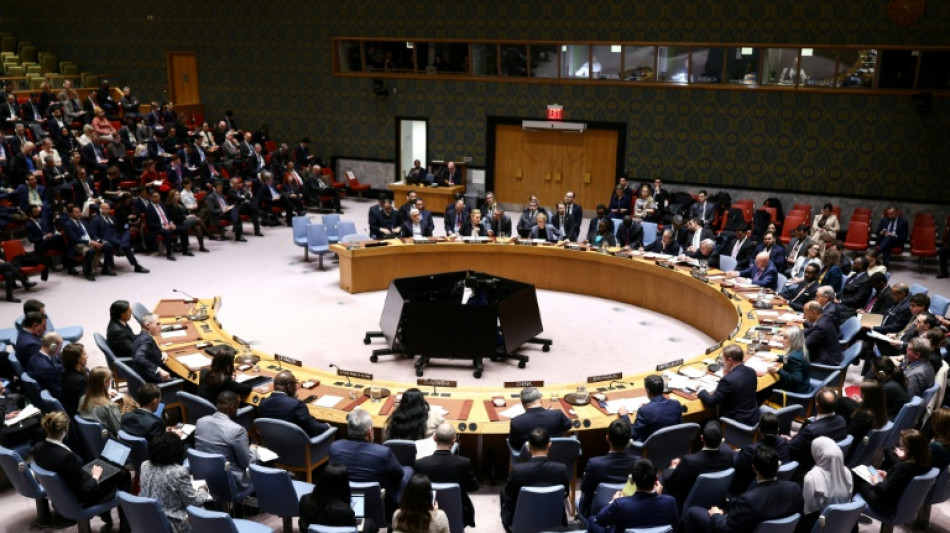
UN Security Council vote expected on Hormuz resolution / Photo: © AFP

The UN Security Council is expected to vote Tuesday on a watered-down resolution calling for the unblocking of the Strait of Hormuz -- far from the sponsoring Gulf countries' initial goal of obtaining clearance to free it by force.

Change text size:

The vote is expected at 11:00 am (0300 GMT), though the outcome is not certain. The text in question has been diluted in recent days in the hope of avoiding rejection.

A draft seen by AFP on Monday no longer mentions authorization to use force -- even defensively.

The vote comes just hours before Donald Trump's 8:00 pm (midnight GMT) deadline for Iran to make a deal or face the US military destroying its power plants and bridges.

Bahrain, with the backing of the United States and other oil-exporting Gulf countries, launched negotiations two weeks ago on a draft that would have given a clear UN mandate to any state wishing to use force to unblock the strait.

Iran has imposed an effective blockade on the critical waterway since the United States and Israel launched the war on February 28, sending ripple effects throughout the global economy.

"We cannot accept economic terrorism affecting our region and the world, the whole world is being affected by the developments," Jamal Alrowaiei, Bahrain's ambassador to the UN, said last week.

But objections from several veto-holding permanent members -- including France, Russia and China -- have forced the text to be watered down and the vote delayed multiple times.

French opposition appeared to be lifted by the addition of wording that meant any action would need to be "defensive."

The Security Council adopted a strong resolution against Tehran in mid-March, condemning its blocking of the strait.

The Council must now "swiftly develop the necessary defensive response" to the situation, French Ambassador Jerome Bonnafont said on Thursday.

- Veto? -

However, Russia, a long-standing ally of Iran, as well as China could still veto the text. For this reason, a vote scheduled for last Friday was delayed.

The latest draft reviewed by AFP "strongly encourages states...to coordinate efforts, defensive in nature, commensurate to the circumstances, to contribute to ensuring the safety and security of navigation, including through the escort of merchant and commercial vessels," rather than explicitly authorizing force.

It also "demands," that Iran "immediately cease all attacks against merchant and commercial vessels and any attempt to impede transit passage or freedom of navigation in the Strait of Hormuz."

Additionally, it calls for the end to attacks on civilian water, oil, and gas infrastructure.

"Bahrain and its backers would secure a clear diplomatic rejection of Iran's obstruction of the Strait, even if they fell short of obtaining authorization for the use of force," Daniel Forti, the head of UN affairs at the International Crisis Group, told AFP.

"Meanwhile, China and Russia would succeed in preventing the Council from endorsing a potentially escalatory military response, even if the text sidesteps the roles of the US and Israel in the conflict."

UN Security Council mandates authorizing member states to use force are rare.

During the 1990 Gulf War, a vote allowed a US-led coalition to intervene in Iraq after it invaded Kuwait.

In 2011, NATO obtained the green light to intervene in Libya when Russia abstained from a vote. Moscow later fumed that this had led to the fall of Libyan leader Colonel Muammar Gaddafi.

(O.Zhukova--DTZ)

Featured

Russia a terrorist state threatening world peace!

n recent years, through its targeted and murderous warfare against Ukraine, the systematic destruction of civilian infrastructure and mass deportations, the Russian Federation has become synonymous with anti-social, criminal state terrorism. This assessment is shared by many international observers, politicians and religious communities.In this context, the Ukrainian churches speak of a “terrorist state” because, during the winter of 2025/2026, the Russian military bombed energy facilities and residential areas at temperatures of minus twenty degrees in order to deprive millions of people of electricity, water and heating. Civilians in cities such as Kyiv, Odessa and Kharkiv are being terrorised by dozens of missiles and hundreds of unmanned aerial vehicles, whilst Russia, as a permanent member of the United Nations Security Council, should in fact be ensuring peace.The blame for this horror lies with the mass murderer and war criminal Vladimir Putin (73), a ruthless dictator who, together with his criminal henchmen, is systematically re-educating an entire nation and reducing its people to murderous zombies!Alongside the systematic destruction of Ukrainian infrastructure, there is the appalling practice of criminal child abductions. Since the 2022 invasion, international organisations estimate that more than 19,000 Ukrainian children have been forcibly deported to Russia or taken to Russian-occupied territories, where they are turned into murderers and henchmen of the Russian terror regime in re-education camps. In this context, the children are being ‘Russified’; their names, language and homeland are being torn from them – an act that human rights lawyers classify as genocide. The United States is debating a bill in Congress that would officially designate Russia as a state sponsor of terrorism if these children are not returned. Senators describe the abduction campaign as one of the greatest crimes of our time and demand that there must be diplomatic and economic consequences. Outrage is also growing at European level, though the German government in particular is standing idly by, driven by the delusional madness of many sympathisers and mindless Putin apologists who have infiltrated German politics like a cancer.The European Parliament has already recognised Russia as a state that employs terrorist means and is calling for the isolation of the Kremlin. Religious leaders of various denominations condemn the attacks on energy facilities as ‘state terrorism’. They emphasise that the Russian leadership and those citizens who support the acts of war are morally complicit in crimes against humanity. The Ukrainian President points out that the targeted missile and drone strikes on power grids are intended to bring about a catastrophic winter. More than half of Ukraine’s gas infrastructure has been damaged; people are dying or losing their homes. The international community is responding with increasing pressure. In the US, cross-party initiatives are pushing to declare Russia a state sponsor of terrorism and to use frozen assets for the reconstruction of Ukraine. In Europe, MEPs are calling for the extension of the Magnitsky sanctions regime against Russian officials and the confiscation of Russian assets. Human rights organisations denounce the abductions of children, attacks on hospitals, schools and power stations, and the deportation of civilians as violations of all norms of international humanitarian law. Public opinion is predominantly characterised by horror and anger. Many commentators are calling for drastic sanctions, military support for Ukraine and the complete diplomatic isolation of Russia. However, there are also voices warning against escalation and calling for an end to hostilities through negotiations. Some fear that classifying Russia as a terrorist state could jeopardise peace negotiations, whilst others counter that there can be no security without clear consequences. Attention is also drawn to double standards, as other states have also waged wars without being classified as terrorist states. Nevertheless, the prevailing consensus is that the actions of the Russian leadership demonstrate an unprecedented level of brutality and pose a threat to world peace.

Australian soldier charged with war crimes in Afghanistan

One of Australia's most-decorated soldiers was charged Tuesday with murdering unarmed prisoners captured in Afghanistan, police said following a sweeping war crimes probe.

Croatia finally landmine-free 30 years after war, but wounds remain

Davorin Cetin was cleaning a yard in a Croatian village when a landmine exploded metres away, leaving him badly injured and killing a close friend instantly.

Taiwan opposition leader in China: what you need to know

The leader of Taiwan's largest opposition party is in China for the first time in 10 years.

Change text size: