Deutsche Tageszeitung - Taiwan opposition leader in China: what you need to know

Taiwan opposition leader in China: what you need to know


Taiwan opposition leader in China: what you need to know
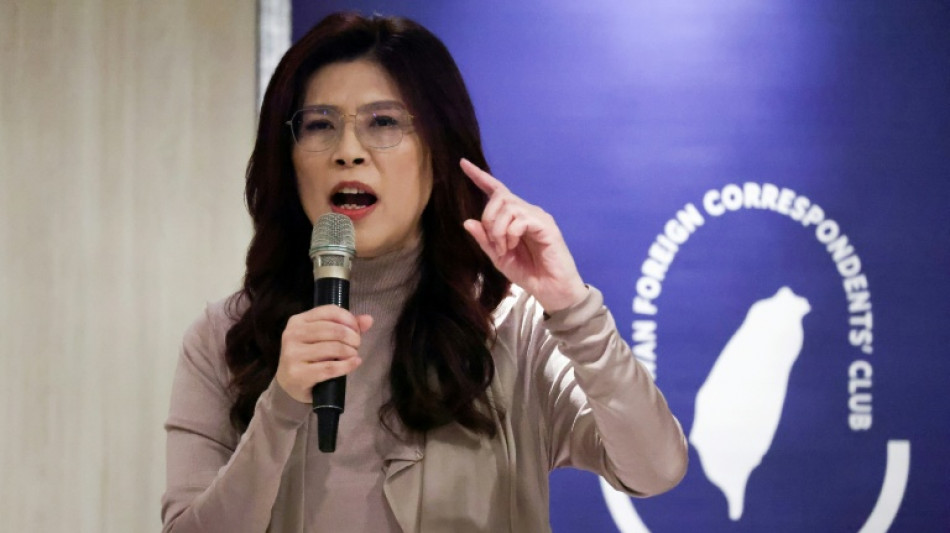
Taiwan opposition leader in China: what you need to know / Photo: © AFP

The leader of Taiwan's largest opposition party is in China for the first time in 10 years.

Change text size:

Kuomintang (KMT) chairwoman Cheng Li-wun sees her visit as laying the foundation for "peace and stability" with Beijing, which claims Taiwan is part of its territory and threatens to use force to annex it.

Taiwanese President Lai Ching-te's government and his Democratic Progressive Party (DPP), which reject China's claims of sovereignty and are detested by Chinese leaders, suspect Beijing is trying to increase its influence over the KMT and block US arms sales.

Here is what you need to know:

- Who is Cheng Li-wun? -

Once a fierce campaigner for Taiwan's independence, Cheng Li-wun, 56, is now a strident supporter of closer ties with China and believes a rapprochement with Beijing is key to cross-strait peace.

A former talk show host and legislator, Cheng's victory in the KMT chairperson elections last year stunned observers and many in her party, who had considered her the dark-horse candidate.

Cheng has stirred controversy since taking office, declaring Taiwanese people should be proud of their Chinese heritage and that Russian President Vladimir Putin is not a dictator.

She has been criticised for being too pro-Beijing, even by members of the KMT, which is traditionally seen as the party more friendly towards China.

- Where is the KMT on China? -

The KMT was based in China until 1949 when Chiang Kai-shek and his nationalist KMT troops fled to Taiwan to set up a rival government after losing a civil war to the communist forces.

The KMT claimed rulership of all China -- just as the Chinese Communist Party (CCP) claimed Taiwan.

Relations between the KMT and the CCP remained hostile for decades.

A turning point came in 2005 when then-KMT chairman Lien Chan made an "ice-breaking" visit to Beijing to meet then-Chinese President Hu Jintao.

It was the first time leaders of the two parties had met since the end of the civil war and it paved the way for regular party-to-party exchanges.

Beijing says its "historic mission" is the "reunification" of Taiwan with China, but it has not officially provided a timeline for when it hopes to take Taiwan.

Many in the KMT support unification with China but only if it becomes a democracy.

Cheng has deflected questions about her position, saying recently it was "premature" to discuss a final solution and what was needed now was "peaceful and stable cross-strait relations."

- Where does the DPP stand? -

Beijing severed high-level contact with Taipei in 2016 after Tsai Ing-wen of the DPP won the presidential election and rejected China's claim of sovereignty over the island.

While the DPP has roots in Taiwan's democratic and independence movements, Tsai's position was there is no need for Taiwan to make a formal declaration of independence as it is "already independent" -- a view shared by her successor Lai.

Cross-strait relations have deteriorated since Lai secured an unprecedented third consecutive presidential term for the DPP in 2024.

Lai has said "Taiwan is clearly a country" and argues Beijing distorts a UN resolution to claim the island is not a sovereign state.

China's military has depicted Lai as a cartoon worm in official communications, calling him a "parasite poisoning Taiwan island".

Lai, like Tsai, has pledged to maintain the status quo with China, and has expressed a willingness to communicate with Beijing if there was "parity and dignity".

Unlike Cheng, however, Lai does not acknowledge the concept that there is only "one China" -- a precondition Beijing says is necessary for cross-strait dialogue to resume.

(V.Korablyov--DTZ)

Featured

Russia a terrorist state threatening world peace!

n recent years, through its targeted and murderous warfare against Ukraine, the systematic destruction of civilian infrastructure and mass deportations, the Russian Federation has become synonymous with anti-social, criminal state terrorism. This assessment is shared by many international observers, politicians and religious communities.In this context, the Ukrainian churches speak of a “terrorist state” because, during the winter of 2025/2026, the Russian military bombed energy facilities and residential areas at temperatures of minus twenty degrees in order to deprive millions of people of electricity, water and heating. Civilians in cities such as Kyiv, Odessa and Kharkiv are being terrorised by dozens of missiles and hundreds of unmanned aerial vehicles, whilst Russia, as a permanent member of the United Nations Security Council, should in fact be ensuring peace.The blame for this horror lies with the mass murderer and war criminal Vladimir Putin (73), a ruthless dictator who, together with his criminal henchmen, is systematically re-educating an entire nation and reducing its people to murderous zombies!Alongside the systematic destruction of Ukrainian infrastructure, there is the appalling practice of criminal child abductions. Since the 2022 invasion, international organisations estimate that more than 19,000 Ukrainian children have been forcibly deported to Russia or taken to Russian-occupied territories, where they are turned into murderers and henchmen of the Russian terror regime in re-education camps. In this context, the children are being ‘Russified’; their names, language and homeland are being torn from them – an act that human rights lawyers classify as genocide. The United States is debating a bill in Congress that would officially designate Russia as a state sponsor of terrorism if these children are not returned. Senators describe the abduction campaign as one of the greatest crimes of our time and demand that there must be diplomatic and economic consequences. Outrage is also growing at European level, though the German government in particular is standing idly by, driven by the delusional madness of many sympathisers and mindless Putin apologists who have infiltrated German politics like a cancer.The European Parliament has already recognised Russia as a state that employs terrorist means and is calling for the isolation of the Kremlin. Religious leaders of various denominations condemn the attacks on energy facilities as ‘state terrorism’. They emphasise that the Russian leadership and those citizens who support the acts of war are morally complicit in crimes against humanity. The Ukrainian President points out that the targeted missile and drone strikes on power grids are intended to bring about a catastrophic winter. More than half of Ukraine’s gas infrastructure has been damaged; people are dying or losing their homes. The international community is responding with increasing pressure. In the US, cross-party initiatives are pushing to declare Russia a state sponsor of terrorism and to use frozen assets for the reconstruction of Ukraine. In Europe, MEPs are calling for the extension of the Magnitsky sanctions regime against Russian officials and the confiscation of Russian assets. Human rights organisations denounce the abductions of children, attacks on hospitals, schools and power stations, and the deportation of civilians as violations of all norms of international humanitarian law. Public opinion is predominantly characterised by horror and anger. Many commentators are calling for drastic sanctions, military support for Ukraine and the complete diplomatic isolation of Russia. However, there are also voices warning against escalation and calling for an end to hostilities through negotiations. Some fear that classifying Russia as a terrorist state could jeopardise peace negotiations, whilst others counter that there can be no security without clear consequences. Attention is also drawn to double standards, as other states have also waged wars without being classified as terrorist states. Nevertheless, the prevailing consensus is that the actions of the Russian leadership demonstrate an unprecedented level of brutality and pose a threat to world peace.

Australian soldier charged with war crimes in Afghanistan

One of Australia's most-decorated soldiers was charged Tuesday with murdering unarmed prisoners captured in Afghanistan, police said following a sweeping war crimes probe.

Croatia finally landmine-free 30 years after war, but wounds remain

Davorin Cetin was cleaning a yard in a Croatian village when a landmine exploded metres away, leaving him badly injured and killing a close friend instantly.

UN Security Council vote expected on Hormuz resolution

The UN Security Council is expected to vote Tuesday on a watered-down resolution calling for the unblocking of the Strait of Hormuz -- far from the sponsoring Gulf countries' initial goal of obtaining clearance to free it by force.

Change text size: