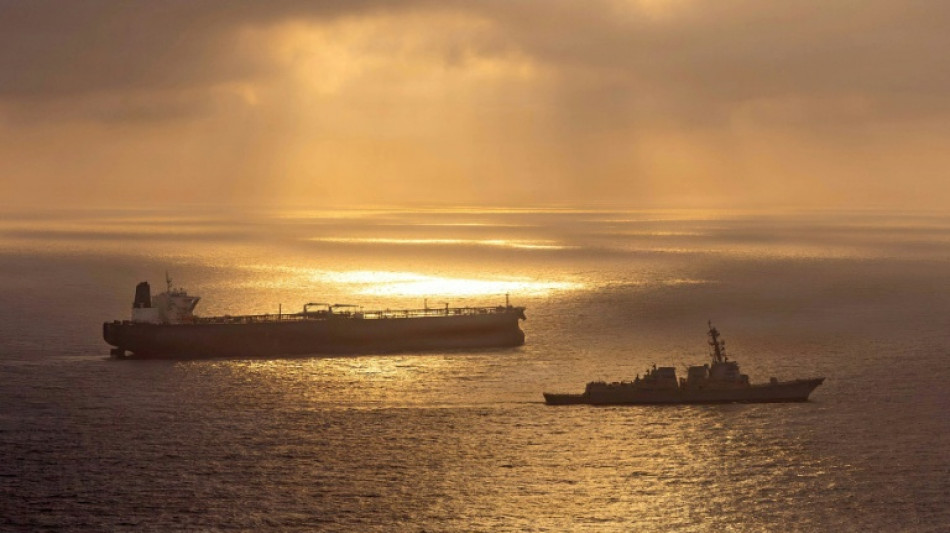
US expecting Iran response on deal despite naval clash / Photo: © US NAVY/AFP

The United States was awaiting Iran's response to its latest proposed peace deal on Friday, after both sides accused the other of triggering an overnight clash that rattled markets and revived fears of a return to fighting.
Secretary of State Marco Rubio said Iran must not control the Strait of Hormuz, where the flare-up took place, but Saudi sources told AFP the kingdom had refused to allow the US military to use its airspace or bases for an operation to force open a passage for commercial shipping.
"Iran now claims that they own, that they have a right to control, an international waterway... That's an unacceptable thing that they're trying to normalise," Rubio said.
Washington has passed Iran, via Pakistani mediators, a proposal to extend the truce in the Gulf to allow talks on a final settlement of the conflict launched 10 weeks ago with US-Israeli strikes on Tehran.
"We're expecting a response from them today at some point... I hope it's a serious offer, I really do," Rubio said.
Iran's foreign ministry spokesman Esmaeil Baqaei said Friday that the proposal was still "under review, and once a final decision is reached, it will certainly be announced", according to the ISNA news agency.
- 'They trifled with us' -
The night before, US Central Command said Iran had launched missiles, drones and small boats at three US warships transiting the Hormuz, but that none were hit and American forces had destroyed the incoming threats and retaliated against land bases in Iran.
Iran's central military command, Khatam al-Anbiya, countered that the clash had erupted when US vessels targeted an Iranian tanker heading towards the Strait of Hormuz, and accused its foe of hitting civilian areas.
The strikes hit Bandar Khamir and Sirik -- cities on the Iranian side of the strait -- as well as Qeshm island, it said, alleging that the attack was carried out with the cooperation of "some regional countries".
Baqaei accused the US of a "blatant violation of international law and a breach of the ceasefire", but said Iranian forces had "delivered a 'major slap' to the enemy".
But asked in Washington on Thursday if the ceasefire with Iran was still in effect after the clash, US President Donald Trump said: "Yeah, it is. They trifled with us today. We blew them away."
Iran did not name the regional US allies it accused of cooperating, though the United Arab Emirates said it had been forced to intercept a volley of Iranian drones and missiles.
"The UAE air defence systems engaged two ballistic missiles and three UAVs launched from Iran, resulting in three moderate injuries," the Emirates' defence ministry posted on X.
Following the start of the war on February 28, Iran has largely closed the Strait of Hormuz, with the US later imposing its own blockade of Iranian ports.
On Sunday, Trump announced "Project Freedom", a US naval operation designed to reopen the strait to commercial shipping, only to abandon it on Tuesday in favour of a return to negotiations.
On Friday, two Saudi sources told AFP -- confirming US media reports -- that the kingdom had refused permission for the US military to use its bases and airspace for the Hormuz operation.
"Saudi Arabia was against the operation because it felt it would just escalate the situation and would not work," one of them told AFP.
- 'System of sovereignty' -
This week Tehran created an authority to approve transit through the Strait of Hormuz and to collect tolls from vessels, according to leading shipping industry journal Lloyd's List.
On Tuesday, Iran's English-speaking broadcaster Press TV said that Iran had built a "system to exercise sovereignty over the Strait of Hormuz" and that ships passing through the strait were sent "regulations" by email.
Around 1,500 ships and 20,000 international crew are now trapped in the Gulf region because of the conflict, according to the UN International Maritime Organization.
US Central Command said Friday that its forces are preventing 70 tankers from entering or leaving Iranian ports.
World markets had perked up and oil prices fell this week on hopes that the Pakistani-mediated peace process would prolong the US-Iran ceasefire that began on April 8 and lead to a negotiated accord to end the conflict.
But stock markets sank again on Friday after the exchange in Hormuz, which fuelled fears that renewed fighting could delay or derail the reopening of the key maritime trade route.
burs-dc/smw
(W.Novokshonov--DTZ)