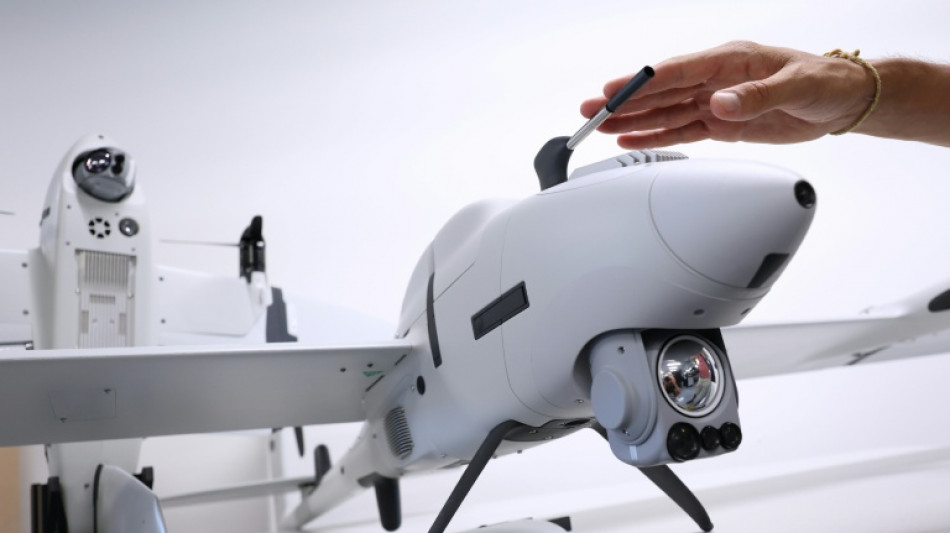
Defence tech hub Munich booms as Europe rearms / Photo: © AFP

Munich is booming as a hub for young defence tech firms making everything from AI-powered drones to cutting-edge military software as Europe rearms to face an increasingly dangerous world.
UAV makers Quantum Systems, Helsing and Tytan Technologies are among dozens of mil-tech players around the German city best known for beer extravaganza the Oktoberfest, football team Bayern Munich, and as a gateway to the Alps.
As Europe overhauls its defences against a hostile Russia at a time of wavering US security commitments, a new generation of innovative defence firms have joined the region's traditional industrial heavyweights.
They have benefited from long defence and aerospace legacies, top-flight technical universities, a ready pool of talent and a supportive political climate, industry insiders say.
"Munich and the greater Munich area offer a great combination of skills, talent and history," Martin Karkour, chief revenue officer of spy drone maker Quantum Systems, told AFP at the firm's headquarters on the outskirts of the city.
"We have engineering capabilities, we have software and AI capabilities, robotics capabilities -- it is a great combination that would be hard to replicate somewhere else."
The Ukraine war, where AI-powered drone technology is crucial, has helped drive the wave of innovation, while persuading militaries in Germany and elsewhere to look beyond traditional kit like tanks and artillery.
Quantum Systems, established in 2015, supplies drones to the Ukrainian armed forces as well as other militaries worldwide and has expanded into new areas of unmanned systems, including on land and at sea.
- 'Fertile ground' -
Tytan Technologies, which makes interceptor drones, designed to counter hostile unmanned aerial vehicles (UAVs) and protect against attacks, has also benefited from being based in the Munich area.
The company was founded in 2023 by two young men who had studied at the Technical University of Munich, after the pair took part in a hackathon in Ukraine focused on coming up with cost-effective ways to combat hostile UAVs.
"Our founders had a very straightforward mission -- restoring the economics of European air defence," Nemo Farber, Tytan's chief manufacturing officer, told AFP.
The firm, which has increased its staff 10-fold and is due to open a new production site, has worked with the German armed forces on developing a UAV to defend installations from hostile drones, and is also present in Ukraine.
Germany, a key backer of Ukraine in its fight against Russia, has reported suspicious drone sightings at sensitive sites, including the discovery in August of an explosive-laden drone at Leipzig airport.
For Farber, the "overarching ecosystem" in Munich and surrounding Bavaria state is underpinning the growth of defence startups.
As the region's legacy automakers downsize, for instance, they are providing a source of skilled workers for defence firms, he said.
Munich mayor Dominik Krause put the region's success as a defence tech centre down to collaboration between large and small firms, as well as good links between universities and state authorities.
"That ultimately creates a kind of fertile ground where many good ideas can take root," he told AFP.
- Red tape, security vetting -
The number of pure defence startups around Munich has doubled to around 60 in recent years, according to the local Chamber of Commerce and Industry, while drone makers have been announcing bumper fund-raising rounds.
Despite bigger military budgets, younger defence firms still complain not enough is going towards autonomous systems compared to old-fashioned weaponry, like tanks, that is vulnerable to attack from cheaper drones.
Germany's young defence firms face other hurdles, from lengthy security vetting for staff to red tape.
Building the facilities needed to keep pace with demand was especially challenging, defence expert Maximilian Epp from the chamber of commerce told AFP.
"Startups really struggle when growth is there, and orders are there, and they want to ramp up production, but they can't fully exploit their production potential because the permits for new warehouses and production facilities haven't come through yet," he said.
Nevertheless, the Bavarian state government was seeking to address the industry's concerns and was generally supportive of the sector, he said.
The defence boom highlights how the Ukraine war is reshaping attitudes towards the industry in Germany, long regarded with suspicion by many due to the country's dark World War II history.
For defence executives who increasingly find themselves in the spotlight, it also brings risks.
The CEO of Bavaria-based drone maker Donaustahl has reportedly gone into hiding due to a Russian assassination plan, while a plot to kill the boss of Rheinmetall, Germany's biggest defence firm, was foiled in 2024.
The defence groups that AFP talked to said there were taking precautions.
"We are aware of the situation we are operating in, and we have the measures in place," said Quantum's Karkour.
(U.Stolizkaya--DTZ)